Category: Personal Growth

  • As a Branch Letting Go of Its Leaves

    As a Branch Letting Go of Its Leaves

    Learn from it. Let it go. Repeat.

    I once had a girlfriend, but then one day she dumped me.

    That’s a line from a song by The Vandals. It’s also an experience I had in 2009. She dumped me, and I became very depressed. The bright side is that I wrote a couple of songs about the experience. One of them is called As a Branch Letting Go of Its Leaves, and that song came to mind recently while I was contemplating letting go and moving on.

    At the time, I was taking things personally and living as though my preferences for reality were something that should be pursued, or even enforced. Hence the misery I felt when I didn’t get what I wanted.

    I’m sure the 2009 version of myself would have said that she made me sad. But is that really what happened?

    She didn’t make me feel anything. She expressed her preference for our relationship, which resulted in a change in my circumstances. That change no longer matched my preference, so I felt pain and sadness. And that’s appropriate. Losing something meaningful hurts.

    But I resisted that pain because I didn’t like it, and that’s when my pain and sadness turned into suffering.

    She didn’t make me suffer. My resistance did.

    It’s easier to see in retrospect.

    My resistance came in the form of hoping she would change her mind and wishing things were different than they were. It’s akin to yelling at the sky when it’s raining on the day I planned to have a picnic. I can yell myself hoarse, but I can’t change the rain.

    Wanting the rain to stop isn’t necessarily a problem. Neither is wanting a relationship to continue. The trouble begins when I can’t accept that reality isn’t cooperating with my preferences.

    Looking back, did I really want her to go against her own preferences to satisfy mine? On some level, yes. But if I give it honest consideration, of course not. Nothing good comes from imposing your will on someone else.

    I was deeply attached to my preference, and the depth of that attachment was likely connected to my own insecurity. That’s a whole other trail to follow another day.

    In my sadness, I wrote a song using the metaphor of a tree dropping its leaves in autumn to represent how I wanted to let go of my sadness. It was September when she dumped me, and I held onto that suffering well into the winter. I don’t recall exactly when I wrote the song.

    It’s interesting to consider my old lyrics through the lens of my current understanding and awareness. They take on more meaning to me now, without diminishing the meaning they held for me then.

    But this isn’t all about nostalgia. I have a simple thought to share about trees.

    The Tree and Its Leaves

    Recently, while contemplating letting go of whatever no longer serves me—resisted energy, limiting beliefs, or whatever else I might be carrying—my old song came to mind.

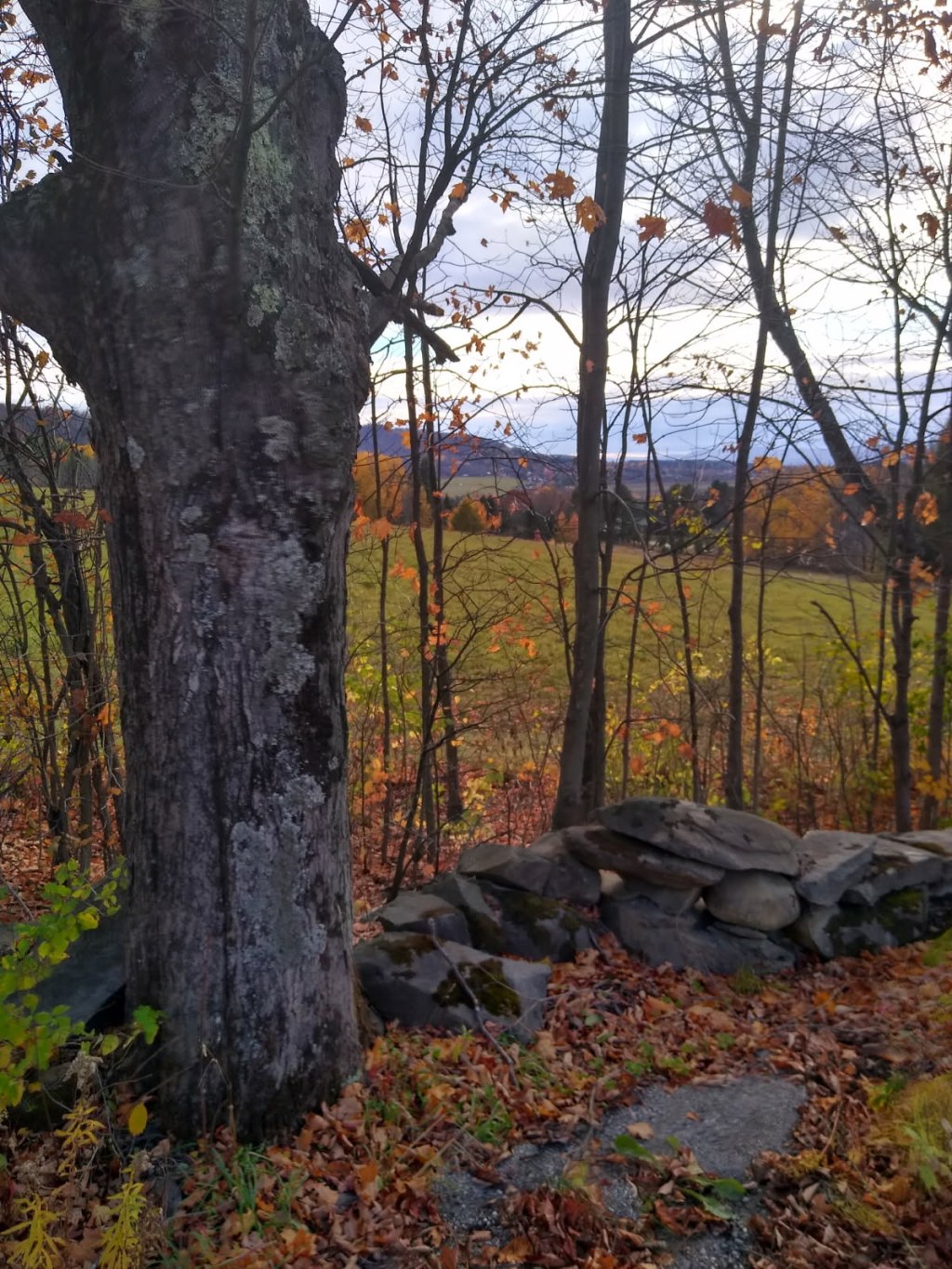
    I pictured a massive tree standing alone in a field. Some leaves were already on the ground, some were drifting away on the wind, and others remained attached to the branches.

    Can you picture it?

    A warning before we continue: I’m not an arborist, and what follows isn’t intended to be a scientific explanation of trees. The symbolism isn’t to scale. It’s cartoonishly illustrative. Bear with me.

    Looking at this imaginary tree, I wondered: What happens when a tree holds onto its leaves past their time?

    I’m not suggesting a tree does this willfully, but I’m not saying it doesn’t either. I’m not the boss of the trees.

    I live in Vermont, where most deciduous trees drop their leaves in autumn. The evergreens, of course, do their own thing.

    Imagine a tree that doesn’t release its leaves as winter approaches. When the snow and ice arrive, those leaves provide additional surfaces for accumulation and resistance to the wind. Under the right conditions, that extra burden could contribute to branches breaking.

    The leaves that once served the tree during its season of growth have become something it would be better off releasing.

    I think we do something similar.

    We hold onto experiences, expectations, beliefs, and emotional reactions long after the circumstances that produced them have passed. What once seemed important, meaningful, or even necessary can become a burden when we refuse to let it go.

    When my girlfriend ended our relationship, she was, in essence, telling me it was time for a new season. But I didn’t want a new season. I wanted to stay in the one I was enjoying.

    And so I resisted.

    The relationship had ended, but I continued trying to live in it through my thoughts, hopes, and expectations. I couldn’t change what had happened, but I could keep wishing it hadn’t happened. And I did.

    It hurt to lose the relationship, and that’s okay. What I didn’t understand at the time was that I could allow myself to feel that hurt without trying to change the circumstances that caused it.

    Perhaps it hurts a leaf to fall from a tree. If we anthropomorphize the leaf, I imagine the experience would be terrifying. One moment it’s securely attached to a branch, and the next it’s drifting toward an uncertain future.

    But nature says it’s time to go.

    What Falls Away Can Still Serve Us

    There’s another part of this metaphor that I find particularly meaningful.

    When a tree drops its leaves, they don’t simply disappear. They fall to the ground, where they gradually decompose and contribute nutrients to the surrounding ecosystem. That ecosystem, in turn, supports the tree’s future growth.

    The leaves have served their purpose in one season, but they still have something to contribute to the next.

    Perhaps our experiences work similarly.

    If I continue clinging to an experience, wishing it were different or trying to preserve something that has already passed, I may prevent myself from fully appreciating what that experience has to teach me.

    My relationship in 2009 didn’t continue the way I wanted it to. That was painful. But the experience also gave me opportunities to learn about attachment, insecurity, personal preferences, and the difference between pain and suffering.

    I couldn’t appreciate all of that at the time. I was too busy wishing things were different.

    Now, many years later, I can look back on the experience without the same emotional burden. I can remember the relationship, appreciate what it meant to me, recognize what I learned, and even enjoy the songs I wrote because of it.

    The experience hasn’t changed. My relationship with it has.

    That’s what I mean by letting go.

    Letting Go Isn’t Forgetting

    Letting go doesn’t mean forgetting what happened, pretending it didn’t matter, or denying the emotions that accompanied it.

    We’re talking about releasing our resistance to the experience, not erasing the experience itself.

    Memories can remain without requiring us to relive the emotional struggle that once accompanied them. We can remember being hurt without continuing to fight the circumstances that hurt us.

    The tree doesn’t need to hold onto last autumn’s leaves to benefit from them. Their contribution becomes part of the environment in which the tree continues to grow.

    Likewise, I don’t need to hold onto the suffering associated with my past to benefit from what I’ve learned.

    And perhaps that’s the part of my old song that means the most to me now.

    In 2009, I wanted to let go because I didn’t want to hurt anymore. Today, I see letting go as something more than an escape from pain. It’s a willingness to experience life as it unfolds, to allow things to change, and to recognize that something can be meaningful without needing to last forever.

    The tree doesn’t stop growing because it loses its leaves. Losing its leaves is part of how it continues growing.

    And when another season comes, it grows new ones.

    Learn from it. Let it go. Repeat.
  • Like a Movie…

    You just saw a movie preview and it looks great! It’s a story that you are familiar with, has actors you like, and you expect it will be an instant favorite. You immediately pre-order a ticket and arrange your schedule to attend the premiere. You arrive early, buy the snacks, and find a seat. As you wait for the previews to start, the theater is playing commercials for trucks and pharmaceuticals. When did theaters start showing commercials before a movie? That’s annoying. You contemplate how much you just spent on popcorn and a soda. That’s annoying. The previews begin and the speaker on the wall just above your head seems to buzz on the deep bass sounds. That’s annoying!

    Eventually the movie begins and you seem to relax a little. Your excitement comes back, drowning out the minor frustrations you’ve been noticing. A few minutes in and one of the characters comes into the scene but they don’t look or act how you imagined them based on your familiarity with the story. Perhaps it was a book you read. Soon you notice they skip over what you thought was an integral scene for the story. Movies do that sometimes. That’s annoying. It begins again. By the end of the movie you aren’t sure if you enjoyed it or not. That’s not what I expected.

    I think whether or not you enjoyed the movie depends on your level of attachment to your preference. Throughout life we have experiences and form preferences based on those experiences. Subsequent experiences reinforce or adapt our preferences. From Buddhism we hear that the cause of suffering is desire (preference). Does that suggest it is wrong to have preference? I think we can understand the concept without altering the message by adding in the element of attachment to preference. It’s the difference between saying “I want this to happen because I like it” and “I need this to happen in order to be okay.” Attachment in this context means making my sense of well-being conditional upon having a preference met. I think this attachment to preference is the cause of suffering.

    Listening to Michael Singer’s podcast lectures over the last few months I’ve been presented with a story I became familiar with through my earlier life as a practicing Christian. In Luke 22:42 Jesus is praying in Gethsemane, about to take upon himself the troubles of all people in order to atone for them. He says, “Father, if thou be willing, remove this cup from me: nevertheless not my will, but thine, be done.” I used to understand this as Jesus submitting his will to the will of God, but with Singer’s perspective I now see it as an analogy for living life without resistance.

    Jesus starts his prayer with a preference: remove this cup. He then concludes by accepting whatever will come, regardless of his preference. It seems that while Jesus had a preference, he was not attached to it. He could anticipate what was coming without insisting that it unfold differently. He was able to meet reality without resisting it.  After this prayer he was arrested, brought before the rulers to be judged, and ultimately was killed. For the purpose of this article, I’m looking at this story symbolically.

    It is not bad to have preference. It is not bad to have expectations. It is not bad to have expectations born from attached preference, although this might be the recipe for suffering. A movie hit streaming a few months ago that I had heard mostly bad reviews about. I was indifferent to or unfamiliar with the cast. I find the director to be overrated. But the topic of the movie was very interesting. Based on my experiences and preferences, I expected to dislike the movie. One weekend afternoon with nothing to do I put the movie on. I planned to turn it off if it didn’t immediately hook my attention. When the movie ended I wanted more. I thoroughly enjoyed it, in spite of my expectations. I think this is because I wasn’t attached to the preferences that led to my expectation. I didn’t have a high opinion of the director, but could they still make a good movie? Sure. I didn’t know the actors, but could they be great? Sure. People on the internet are saying the movie isn’t any good, but can people on the internet have some wonky opinions? Case in point…

    Let go of your expectations, especially the ones that are based upon your preferences if you are feeling like you need them to be met. Wonky opinion? Perhaps, but give it a try. Practice letting reality be what it is. Practice allowing the universe or God or whatever your belief is to unfold before you. Personally, I believe my spirit entered this life for a purpose. I don’t know what that purpose is, but I think it has to do with growth. I believe that a direction was chosen and a gentle push was applied. All I needed to do was to go with the flow, but I didn’t know. I lacked the wisdom to see how painful experiences could be for my benefit, and I developed preferences to protect what I thought needed to be protected. This resulted in me resisting life, holding on to past experiences, afraid to let them go.

    Surrendering to life or submitting to God’s will doesn’t mean becoming a victim of reality, it means responding to reality. It means accepting that things won’t always match your preference or expectation, so hold them lightly. Experience life as it is and respond to what happens, rather than demand that it be what you want and react when things go askew.  It’s okay to like or dislike a movie. It’s okay to expect a movie to be good or bad. It’s okay to suffer. But if you don’t want to suffer, if you prefer to experience peace, it’s also okay to relax your attachments to preference and release your expectations for reality to be the way you want it to be.

  • The Four Agreements — Don Miguel Ruiz

    The Four Agreements — Don Miguel Ruiz

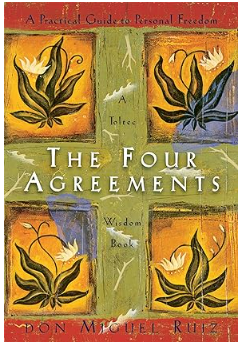
    The Four Agreements introduces the idea that many of our beliefs began as someone else’s opinions. Parents, teachers, religious leaders, and others teach us how life is supposed to work long before we can distinguish opinion from fact. As we adopt these ideas as beliefs, we make agreements with them. But what happens when an agreement no longer serves us? Can we change it? Absolutely. Drawing from the Toltec tradition, Don Miguel Ruiz suggests replacing limiting beliefs with four agreements: Be impeccable with your word. Don’t take anything personally. Don’t make assumptions. Always do your best.

    I recommend this book to anyone interested in understanding how their beliefs developed and how those beliefs influence their daily experiences. It offers a practical way to examine the assumptions we’ve carried through life, question what we’ve accepted as truth, and begin choosing beliefs that support greater peace and personal growth.

    I first read this book in 2017, and it changed the direction of my life. The second agreement, don’t take anything personally, had the greatest impact. I remember leaving my office the day I read it and waiting in my truck to turn onto the road. As another truck passed, I made eye contact with a young man in the passenger seat. He was laughing. Immediately, I became defensive. What’s he laughing at?! As I drove toward the stoplight, I imagined all sorts of reasons this guy might be laughing at me and what I’d say if I confronted him. Then, suddenly, I remembered: Don’t take anything personally. My anger dissolved, I laughed at myself, and said, “Now I get it!” I had observed something, invented a story about it, and made myself angry over a situation I knew almost nothing about. He might have been laughing at me, but why assume that? And even if he was, why make it my problem? By letting go of that anger, I also avoided carrying it home to my family.

    Since then, I’ve recommended this book to countless people and given away dozens of copies. Not everyone connects with it, and I’ve learned that’s perfectly fine. We’re all traveling our own paths, and what changes one person’s life may mean nothing to another. But for those who are ready to question their agreements, this little book might open the door to an entirely different experience of life. And if it doesn’t, that’s great, too.

    A few years ago I made this 8-bar song based on The Four Agreements as part of a challenge issued by YouTube personality Pete Johns.

  • Understanding Experience: Resistance Is a Teacher

    Sometimes we spend more time arguing with what happened than deciding what to do now.

    We replay a conversation. We insist something shouldn’t have happened. We tell ourselves we shouldn’t feel the way we feel.

    Then we become frustrated with ourselves for being frustrated.

    What if those moments could teach us something?

    Life is the sum of its parts

    Consider a simple equation:

    2 + 2 + 2 = 6

    Change one of the numbers:

    2 + 2 + 4 = 8

    Neither answer is good or bad. Each is the complete result of the numbers that went into it.

    Life works similarly. This moment is the culmination of what has happened leading up to it. Some of those things were our decisions. Others occurred outside our control.

    When I describe the present moment as perfect, this is what I mean: complete or whole. The sum of the parts.

    I don’t mean that everything that happened was good, fair, or desirable.

    Whatever happened, here we are.

    We cannot change the equation that brought us to this moment. We can decide what to contribute to the next one.

    What we bring to an experience

    Our experiences contribute to the development of preferences, beliefs, expectations, and habits.

    We learn what we enjoy, what we fear, and how we think people should behave.

    Sometimes a preference becomes an expectation. “I would like this to happen” becomes “This should happen.”

    Imagine planning an outdoor activity because you enjoy sunshine. Then it rains.

    The rain is an event. Your disappointment reflects, in part, the difference between what happened and what you wanted.

    Someone else might welcome the same rain.

    Same weather. Different experiences.

    This gives us something to explore: what happened, and what did I bring to it?

    Feelings are not instructions

    When something happens, your body may react before you consciously understand why.

    Your muscles tighten. Your heart races. You feel heat, fear, anger, or an urge to escape.

    These initial reactions aren’t necessarily chosen.

    But a feeling and an action are different things.

    You can feel anger without yelling. You can experience an urge without immediately following it.

    Awareness begins when we notice the distinction between the event, our interpretation, our feelings, and what we do next.

    Resistance is a teacher

    Imagine running your hand across a piece of wood.

    You feel a rough spot. The friction tells you where attention may be useful.

    You don’t need to become angry with the wood. You have discovered something about what you’re working with.

    Resistance can serve a similar purpose.

    Here, I’m using resistance to mean fighting the reality of what has happened: insisting that it should have been different, or that we cannot work with an experience until it changes.

    Fear itself isn’t necessarily resistance. If you encounter danger, recognizing it and protecting yourself can be an expression of acceptance.

    Acceptance does not require standing still.

    But when we notice ourselves arguing with reality, we can become curious.

    What expectation is involved? What belief feels threatened? What am I demanding from this moment?

    Resistance isn’t bad. It is information.

    Awareness comes before acceptance

    Perhaps you spend two days replaying an argument before recognizing what you’re doing.

    That recognition matters.

    You haven’t failed because you didn’t notice sooner. You have become aware now.

    Next time, you might notice after a few hours. Another time, you might recognize the pattern while it is happening. Difficult circumstances may make it harder again.

    There is no required schedule.

    Awareness of resistance is the beginning of acceptance. You can acknowledge:

    “This is what I’m experiencing right now.”

    You don’t have to understand, approve of, or agree with what happened to accept that it happened.

    You don’t even have to make the resistance disappear.

    Acceptance leaves room for action

    Suppose Tom yells at Mark.

    Mark feels angry and thinks, “He’s disrespecting me!”

    Mark yells back. Tom responds. Each reaction becomes the other person’s next experience.

    Another possibility is that Mark notices his anger and says, “I can talk when we’re both calmer.”

    He might leave or establish a firm boundary.

    Tom’s next response is still up to Tom.

    Mark can choose his contribution without controlling the outcome.

    Even leaving can happen from different internal places. Mark might leave and continue arguing in his head for hours. Or he might leave while acknowledging his anger and allowing himself to experience it.

    And if he notices the mental argument hours later, that is another opportunity to practice.

    Pain and the struggle we add

    Pain and suffering can mean different things to different people.

    In this framework, I use suffering to describe the additional struggle that can arise when we resist an experience.

    “This hurts” acknowledges pain.

    “This shouldn’t be happening” may add an argument with reality.

    Acceptance may soften that additional struggle without removing the pain. Grief can remain. Physical discomfort can remain. We can still need care, support, or help.

    This distinction is an invitation to notice our relationship with pain, not a reason to blame ourselves for being distressed.

    Refinement has no deadline

    A woodworker might begin with 80-grit sandpaper, then move to 120, 180, or something finer.

    The existence of 3000-grit sandpaper doesn’t make the work done with 80 grit worthless.

    Each stage has value.

    The analogy describes a process of refinement, not a ranking of people.

    Learning something at ninety still matters. Learning it at twenty may give us more years to benefit from it. Neither requires turning growth into a race.

    We work with what we notice.

    Don’t resist your resistance

    There is an easy trap here.

    We learn about acceptance, then decide we should be accepting. When we notice resistance, we criticize ourselves.

    Now we’re resisting our resistance.

    If that happens, notice it.

    Now you’re aware of something else.

    Resistance is not evidence that the practice has failed. Resistance is an opportunity to practice.

    Start with a few questions:

    • What happened?
    • What am I experiencing?
    • What am I resisting?
    • Can I allow this experience to be what it is, including the resistance?
    • What can I do now?

    Notice what is happening. Allow yourself to experience it. Learn what you can.

    Then return to living your life.


    For a printable companion to these ideas, download my free guide, Understanding Experience, from the Resources page at ImagineMovingOn.com.

    If you would like to explore these topics further, contact Paul Brodie at paul@imaginemovingon.com to discuss a coaching session.

  • Let the Snowman Melt

    Let the Snowman Melt

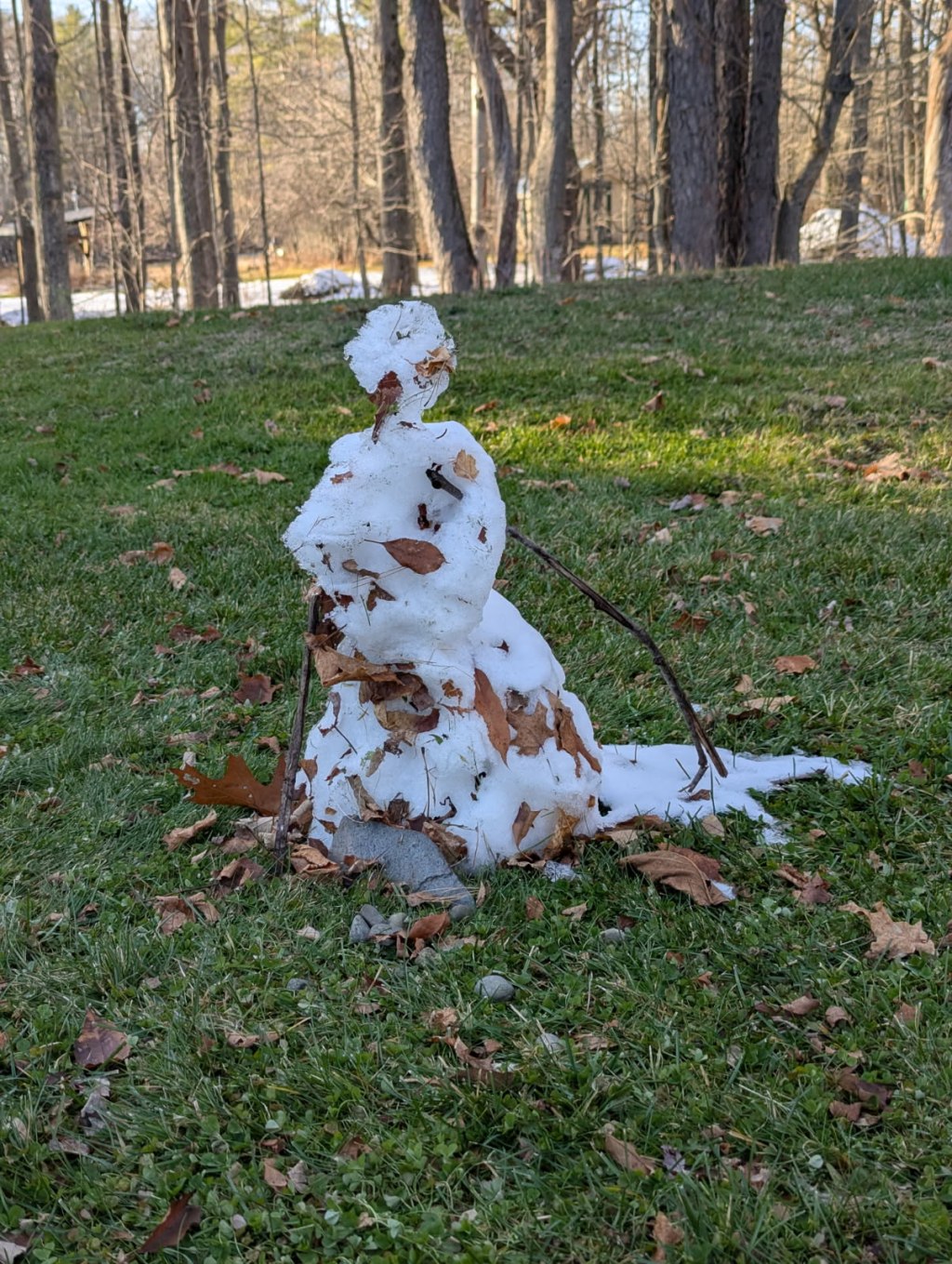
    A few days ago I sent out a request for photos of nature to my family. In starting this blog, I thought it would be nice to have a library of photos I could use to accompany posts when appropriate. One of the photos my mom sent was of a sickly looking snowman on green grass. She told me my children made it. I assume it’s from an early snow in a recent year. Just enough snow to roll up, leaving the yard looking bare. This is the image accompanying this post, likely taken toward the end of the snowman’s existence, given his deteriorating state, which could have been as soon as the same day of his creation.

    Exploring a dream image I experienced a few nights ago, which was recalled when seeing a lock-screen image of the Bisti Wilderness in New Mexico, I found myself exploring erosion, chimneys, and hoodoos. And that is what brought the snowman photo back to my mind, encouraging the following exploration of thoughts.

    But first, let’s look at the snowman.

    It’s freezing cold and the clouds are heavy. Snow falls. Individual flakes accumulate like sand on a beach to the point that it looks like one entity instead of an infinite number of finite entities amassed. The individual snowflakes are rolled together to form the different-sized snowballs that will make the snowman’s body.

    The process is usually filled with laughter and joy. People united in purpose, working to create something fun and beautiful. Adorned with stick arms, rock buttons and eyes, maybe even a carrot for a nose, the joy culminates as the extra knitted hat and scarf are applied to the snowman.

    This snowman is early, though.

    The temperature rises. The clouds part ways. The sun warms the snow and the snowman dissolves, slowly. The fullness that brought happiness melts into a sickly shell of its former grandeur. The builders or other onlookers lament the passage of glory from the once-rotund snowman to whatever this is, with drooping stick arms and falling rock buttons. It looks at you with one eye remaining next to a stained snow empty socket.

    Then the carrot falls.

    Sadness replaces the laughter as the snowman falls from grace. Eventually all that’s left is a wet spot of grass with sticks, stones, and knitted wool lying haphazardly.

    But wait.

    Who said the snowman fell from grace?

    Nothing has gone wrong. The temperature changed. Frozen water became liquid water. The conditions that allowed the snow to fall, accumulate, and become a snowman continued to change, just as they had been changing all along. We are the ones who picked one frame from that process and declared, There! That’s the snowman.

    We don’t usually mourn the individual snowflakes as they’re crushed together into a ball. We call that creation. We don’t lament the loss of three perfectly good snowballs when they’re stacked on top of each other. We’re making something! 

    Then we press the final rock into his face, wrap the scarf around his neck, stand back and admire our creation. He’s done. Or is he?.

    We’re done building him.

    The snowman is still changing. He was changing while we rolled him. He was changing when we put on his scarf. He was changing when we took his picture. He was changing while we stood there admiring him. There was never a completed snowman followed by a deteriorating snowman.There was only a snowman that was new every moment. We just preferred some of those moments to others. And there’s nothing wrong with that.

    This isn’t an exercise in convincing yourself that the pathetic melting snowman is every bit as beautiful as the glorious rotund snowman from an hour earlier. You are allowed to prefer one condition over another. You’re allowed to feel joy when the snow starts falling. You’re allowed to laugh while building the snowman. You’re allowed to admire him when he’s finished.

    And you’re allowed to feel sad when he melts. Sadness isn’t the problem. The trouble begins when preference becomes resistance. I wish the snowman hadn’t melted is a preference. The snowman shouldn’t have melted. Why did this have to happen? This isn’t fair. I wanted him to stay the way he was is an argument with reality. And reality doesn’t care. The snowman is melting. So let the snowman melt.

    That doesn’t mean make the snowman melt. It doesn’t mean want the snowman to melt. It doesn’t mean pretend that you like the melted version as much as the freshly built one. It means let him melt because he is melting. If you really want to preserve him and you happen to own a walk-in freezer, reality has given you something to do. Go get the snowman. But if all that’s left is a scarf lying next to a puddle, demanding yesterday’s snowman from today’s weather isn’t going to bring him back. It only creates resistance to what is.

    This is where the hoodoos that led me back to the snowman become interesting. A hoodoo is a tall, narrow geological formation created through erosion. Harder material at the top can protect the softer material underneath while the surrounding material erodes away. Eventually an incredible formation is left standing. But it’s temporary.

    The erosion that created the hoodoo is still happening. Eventually the cap will fall. The pillar will collapse. Given enough time, the remarkable formation that someone might travel across the country to see will disappear. 

    So when exactly is the hoodoo finished? The process that will eventually destroy it is the same process that created it. Maybe creation and destruction are just names we give to different directions of change based on whether we like what is happening. The same is true of the snowman. Snow accumulates and we call it creation. Snow melts and we call it destruction. But the water doesn’t care. It’s just changing.

    And this brings me to a word I’ve been thinking about lately: ecstasy. I’ve been listening to Michael Singer, who frequently talks about living in a state of ecstasy. I’ve always struggled a little with that word because I associate ecstasy with bliss. An extreme positive emotional state. But I’ve started assigning a different meaning to it.

    What if ecstasy isn’t an abundance of pleasant experience? What if ecstasy is an abundance of experience without resistance? Maybe sadness isn’t the opposite of ecstasy. Maybe resistance is.

    When I was younger, I wanted to win when I played sports or games. Winning was where the joy was. Or perhaps what I thought was joy was sometimes just the relief of not losing. As I’ve gotten older, I’ve discovered that I can enjoy playing without needing to win. I still play to win. That’s part of playing the game. Winning feels good. Losing can be disappointing. I might be frustrated when I strike out or laugh when something goes spectacularly wrong.

    But the joy is no longer dependent on the outcome. The joy is in playing.

    A video game can be fun when I’m defeating the bad guy and it can be fun when the bad guy absolutely destroys me. I don’t have to enjoy those outcomes equally. I can yell at the screen when I lose. I’m still having the experience. Maybe life can be approached the same way.

    If I’m happy, I get to experience happiness. If I’m sad, I get to experience sadness. If I’m excited, afraid, disappointed, angry, peaceful, confused, or filled with grief, I get to experience those too. Sadness is energy. Happiness is energy. Fear is energy. Life is experienced through all of it. Maybe ecstasy isn’t feeling good all the time. Maybe ecstasy is being open to the experience that is actually happening.

    That doesn’t mean I don’t get lost in sadness. It means I don’t have to lose myself in sadness.

    And it certainly doesn’t mean I need to become happy about being sad. That would just be another form of resistance. Now instead of demanding that reality be different, I’m demanding that my emotional response to reality be different. It’s not that I shouldn’t feel sad. I do at times. And I let that happen too.

    Be grateful for joy when joy is present. Be grateful for sadness when sadness is present. Not because sadness is secretly good, but because it is part of the experience of being alive.

    Whatever is present, is.

    Maybe that’s the whole point of all of this.

    Experience what is, when it is.

    Frame by frame.

    The newly fallen snow. The first snowball. The laughter. The carrot. The magnificent finished snowman. The first drip of water. The crooked head. The missing eye. The fallen carrot. The sadness. The puddle. The wet grass.

    We don’t have to decide that every frame is equally preferable. We just don’t have to demand that the movie stop on our favorite one. If you love the snowman, you might want to preserve him. If you love the experience, you have to let him melt. So build the snowman and laugh. Admire him when he’s glorious. Laugh when his carrot falls off. Feel sad when he’s gone. Notice the wet grass when that’s what’s left. Let the snowman melt. Consider the snowman in the field. He neither toils nor spins. Probably because his arms are sticks.