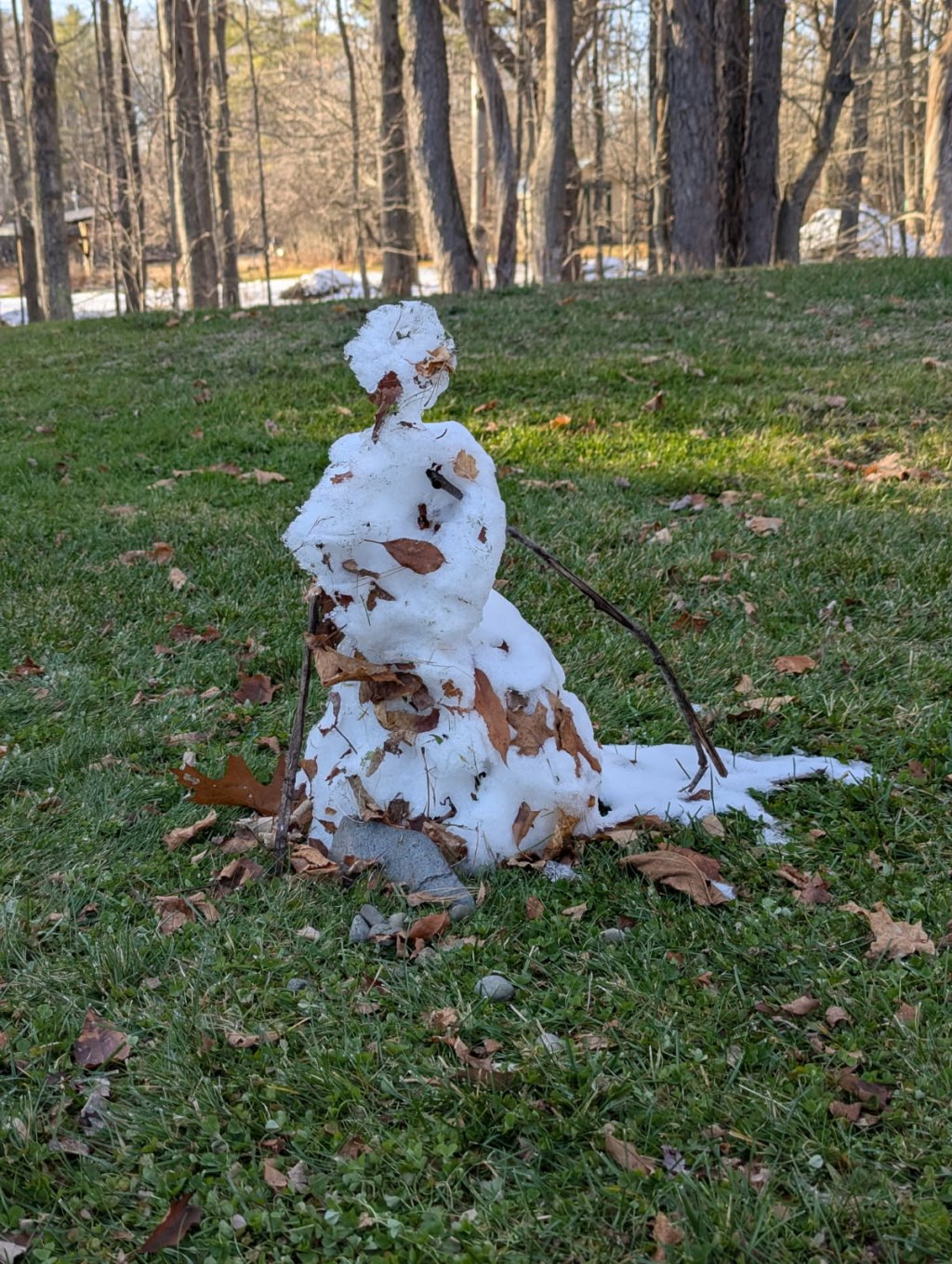
A few days ago I sent out a request for photos of nature to my family. In starting this blog, I thought it would be nice to have a library of photos I could use to accompany posts when appropriate. One of the photos my mom sent was of a sickly looking snowman on green grass. She told me my children made it. I assume it’s from an early snow in a recent year. Just enough snow to roll up, leaving the yard looking bare. This is the image accompanying this post, likely taken toward the end of the snowman’s existence, given his deteriorating state, which could have been as soon as the same day of his creation.
Exploring a dream image I experienced a few nights ago, which was recalled when seeing a lock-screen image of the Bisti Wilderness in New Mexico, I found myself exploring erosion, chimneys, and hoodoos. And that is what brought the snowman photo back to my mind, encouraging the following exploration of thoughts.
But first, let’s look at the snowman.
It’s freezing cold and the clouds are heavy. Snow falls. Individual flakes accumulate like sand on a beach to the point that it looks like one entity instead of an infinite number of finite entities amassed. The individual snowflakes are rolled together to form the different-sized snowballs that will make the snowman’s body.
The process is usually filled with laughter and joy. People united in purpose, working to create something fun and beautiful. Adorned with stick arms, rock buttons and eyes, maybe even a carrot for a nose, the joy culminates as the extra knitted hat and scarf are applied to the snowman.
This snowman is early, though.
The temperature rises. The clouds part ways. The sun warms the snow and the snowman dissolves, slowly. The fullness that brought happiness melts into a sickly shell of its former grandeur. The builders or other onlookers lament the passage of glory from the once-rotund snowman to whatever this is, with drooping stick arms and falling rock buttons. It looks at you with one eye remaining next to a stained snow empty socket.
Then the carrot falls.
Sadness replaces the laughter as the snowman falls from grace. Eventually all that’s left is a wet spot of grass with sticks, stones, and knitted wool lying haphazardly.
But wait.
Who said the snowman fell from grace?
Nothing has gone wrong. The temperature changed. Frozen water became liquid water. The conditions that allowed the snow to fall, accumulate, and become a snowman continued to change, just as they had been changing all along. We are the ones who picked one frame from that process and declared, There! That’s the snowman.
We don’t usually mourn the individual snowflakes as they’re crushed together into a ball. We call that creation. We don’t lament the loss of three perfectly good snowballs when they’re stacked on top of each other. We’re making something!
Then we press the final rock into his face, wrap the scarf around his neck, stand back and admire our creation. He’s done. Or is he?.
We’re done building him.
The snowman is still changing. He was changing while we rolled him. He was changing when we put on his scarf. He was changing when we took his picture. He was changing while we stood there admiring him. There was never a completed snowman followed by a deteriorating snowman.There was only a snowman that was new every moment. We just preferred some of those moments to others. And there’s nothing wrong with that.
This isn’t an exercise in convincing yourself that the pathetic melting snowman is every bit as beautiful as the glorious rotund snowman from an hour earlier. You are allowed to prefer one condition over another. You’re allowed to feel joy when the snow starts falling. You’re allowed to laugh while building the snowman. You’re allowed to admire him when he’s finished.
And you’re allowed to feel sad when he melts. Sadness isn’t the problem. The trouble begins when preference becomes resistance. I wish the snowman hadn’t melted is a preference. The snowman shouldn’t have melted. Why did this have to happen? This isn’t fair. I wanted him to stay the way he was is an argument with reality. And reality doesn’t care. The snowman is melting. So let the snowman melt.
That doesn’t mean make the snowman melt. It doesn’t mean want the snowman to melt. It doesn’t mean pretend that you like the melted version as much as the freshly built one. It means let him melt because he is melting. If you really want to preserve him and you happen to own a walk-in freezer, reality has given you something to do. Go get the snowman. But if all that’s left is a scarf lying next to a puddle, demanding yesterday’s snowman from today’s weather isn’t going to bring him back. It only creates resistance to what is.
This is where the hoodoos that led me back to the snowman become interesting. A hoodoo is a tall, narrow geological formation created through erosion. Harder material at the top can protect the softer material underneath while the surrounding material erodes away. Eventually an incredible formation is left standing. But it’s temporary.
The erosion that created the hoodoo is still happening. Eventually the cap will fall. The pillar will collapse. Given enough time, the remarkable formation that someone might travel across the country to see will disappear.
So when exactly is the hoodoo finished? The process that will eventually destroy it is the same process that created it. Maybe creation and destruction are just names we give to different directions of change based on whether we like what is happening. The same is true of the snowman. Snow accumulates and we call it creation. Snow melts and we call it destruction. But the water doesn’t care. It’s just changing.
And this brings me to a word I’ve been thinking about lately: ecstasy. I’ve been listening to Michael Singer, who frequently talks about living in a state of ecstasy. I’ve always struggled a little with that word because I associate ecstasy with bliss. An extreme positive emotional state. But I’ve started assigning a different meaning to it.
What if ecstasy isn’t an abundance of pleasant experience? What if ecstasy is an abundance of experience without resistance? Maybe sadness isn’t the opposite of ecstasy. Maybe resistance is.
When I was younger, I wanted to win when I played sports or games. Winning was where the joy was. Or perhaps what I thought was joy was sometimes just the relief of not losing. As I’ve gotten older, I’ve discovered that I can enjoy playing without needing to win. I still play to win. That’s part of playing the game. Winning feels good. Losing can be disappointing. I might be frustrated when I strike out or laugh when something goes spectacularly wrong.
But the joy is no longer dependent on the outcome. The joy is in playing.
A video game can be fun when I’m defeating the bad guy and it can be fun when the bad guy absolutely destroys me. I don’t have to enjoy those outcomes equally. I can yell at the screen when I lose. I’m still having the experience. Maybe life can be approached the same way.
If I’m happy, I get to experience happiness. If I’m sad, I get to experience sadness. If I’m excited, afraid, disappointed, angry, peaceful, confused, or filled with grief, I get to experience those too. Sadness is energy. Happiness is energy. Fear is energy. Life is experienced through all of it. Maybe ecstasy isn’t feeling good all the time. Maybe ecstasy is being open to the experience that is actually happening.
That doesn’t mean I don’t get lost in sadness. It means I don’t have to lose myself in sadness.
And it certainly doesn’t mean I need to become happy about being sad. That would just be another form of resistance. Now instead of demanding that reality be different, I’m demanding that my emotional response to reality be different. It’s not that I shouldn’t feel sad. I do at times. And I let that happen too.
Be grateful for joy when joy is present. Be grateful for sadness when sadness is present. Not because sadness is secretly good, but because it is part of the experience of being alive.
Whatever is present, is.
Maybe that’s the whole point of all of this.
Experience what is, when it is.
Frame by frame.
The newly fallen snow. The first snowball. The laughter. The carrot. The magnificent finished snowman. The first drip of water. The crooked head. The missing eye. The fallen carrot. The sadness. The puddle. The wet grass.
We don’t have to decide that every frame is equally preferable. We just don’t have to demand that the movie stop on our favorite one. If you love the snowman, you might want to preserve him. If you love the experience, you have to let him melt. So build the snowman and laugh. Admire him when he’s glorious. Laugh when his carrot falls off. Feel sad when he’s gone. Notice the wet grass when that’s what’s left. Let the snowman melt. Consider the snowman in the field. He neither toils nor spins. Probably because his arms are sticks.


Leave a Reply