Author: imaginemovingon

  • Let the Snowman Melt

    Let the Snowman Melt

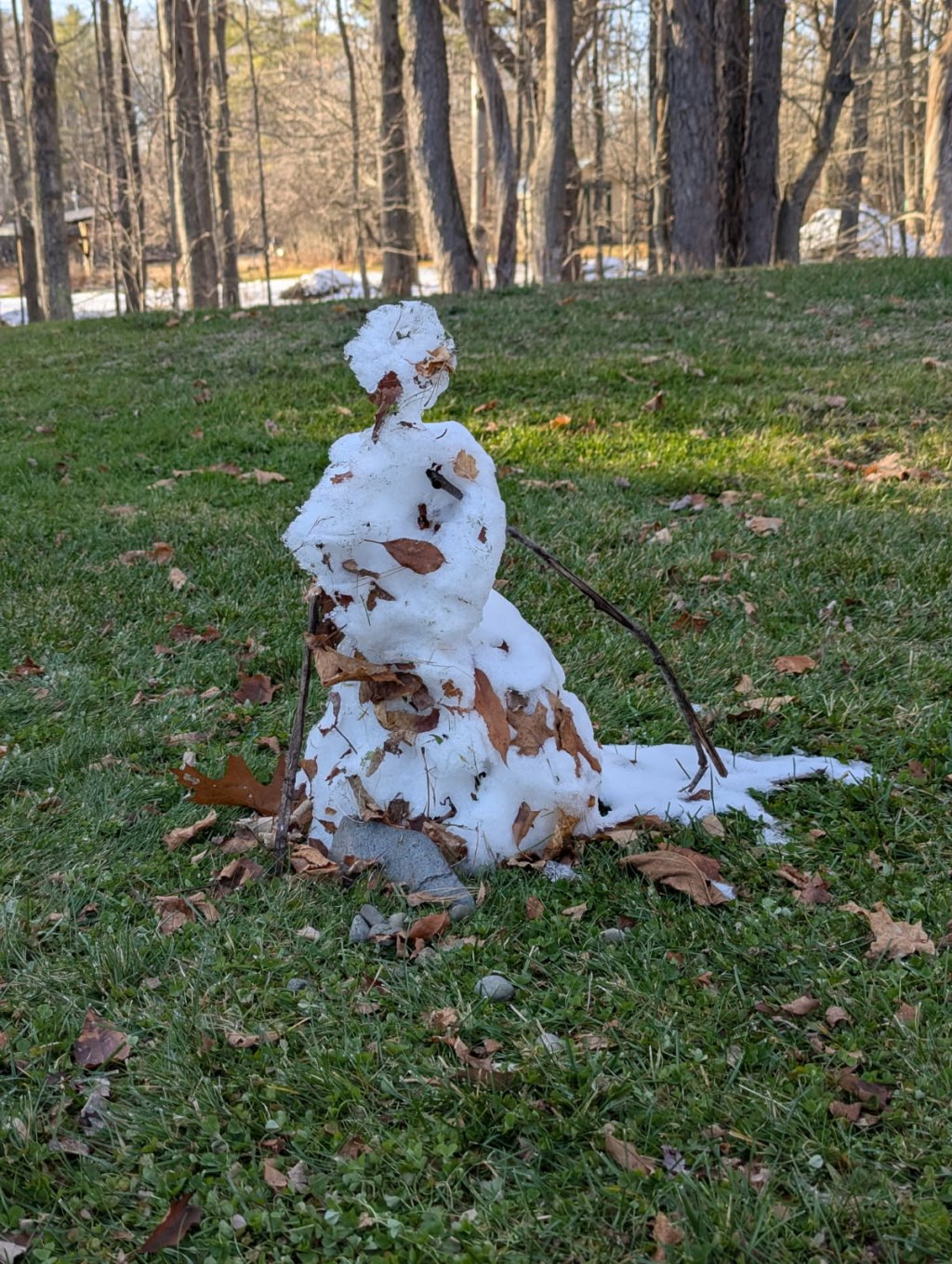
    A few days ago I sent out a request for photos of nature to my family. In starting this blog, I thought it would be nice to have a library of photos I could use to accompany posts when appropriate. One of the photos my mom sent was of a sickly looking snowman on green grass. She told me my children made it. I assume it’s from an early snow in a recent year. Just enough snow to roll up, leaving the yard looking bare. This is the image accompanying this post, likely taken toward the end of the snowman’s existence, given his deteriorating state, which could have been as soon as the same day of his creation.

    Exploring a dream image I experienced a few nights ago, which was recalled when seeing a lock-screen image of the Bisti Wilderness in New Mexico, I found myself exploring erosion, chimneys, and hoodoos. And that is what brought the snowman photo back to my mind, encouraging the following exploration of thoughts.

    But first, let’s look at the snowman.

    It’s freezing cold and the clouds are heavy. Snow falls. Individual flakes accumulate like sand on a beach to the point that it looks like one entity instead of an infinite number of finite entities amassed. The individual snowflakes are rolled together to form the different-sized snowballs that will make the snowman’s body.

    The process is usually filled with laughter and joy. People united in purpose, working to create something fun and beautiful. Adorned with stick arms, rock buttons and eyes, maybe even a carrot for a nose, the joy culminates as the extra knitted hat and scarf are applied to the snowman.

    This snowman is early, though.

    The temperature rises. The clouds part ways. The sun warms the snow and the snowman dissolves, slowly. The fullness that brought happiness melts into a sickly shell of its former grandeur. The builders or other onlookers lament the passage of glory from the once-rotund snowman to whatever this is, with drooping stick arms and falling rock buttons. It looks at you with one eye remaining next to a stained snow empty socket.

    Then the carrot falls.

    Sadness replaces the laughter as the snowman falls from grace. Eventually all that’s left is a wet spot of grass with sticks, stones, and knitted wool lying haphazardly.

    But wait.

    Who said the snowman fell from grace?

    Nothing has gone wrong. The temperature changed. Frozen water became liquid water. The conditions that allowed the snow to fall, accumulate, and become a snowman continued to change, just as they had been changing all along. We are the ones who picked one frame from that process and declared, There! That’s the snowman.

    We don’t usually mourn the individual snowflakes as they’re crushed together into a ball. We call that creation. We don’t lament the loss of three perfectly good snowballs when they’re stacked on top of each other. We’re making something! 

    Then we press the final rock into his face, wrap the scarf around his neck, stand back and admire our creation. He’s done. Or is he?.

    We’re done building him.

    The snowman is still changing. He was changing while we rolled him. He was changing when we put on his scarf. He was changing when we took his picture. He was changing while we stood there admiring him. There was never a completed snowman followed by a deteriorating snowman.There was only a snowman that was new every moment. We just preferred some of those moments to others. And there’s nothing wrong with that.

    This isn’t an exercise in convincing yourself that the pathetic melting snowman is every bit as beautiful as the glorious rotund snowman from an hour earlier. You are allowed to prefer one condition over another. You’re allowed to feel joy when the snow starts falling. You’re allowed to laugh while building the snowman. You’re allowed to admire him when he’s finished.

    And you’re allowed to feel sad when he melts. Sadness isn’t the problem. The trouble begins when preference becomes resistance. I wish the snowman hadn’t melted is a preference. The snowman shouldn’t have melted. Why did this have to happen? This isn’t fair. I wanted him to stay the way he was is an argument with reality. And reality doesn’t care. The snowman is melting. So let the snowman melt.

    That doesn’t mean make the snowman melt. It doesn’t mean want the snowman to melt. It doesn’t mean pretend that you like the melted version as much as the freshly built one. It means let him melt because he is melting. If you really want to preserve him and you happen to own a walk-in freezer, reality has given you something to do. Go get the snowman. But if all that’s left is a scarf lying next to a puddle, demanding yesterday’s snowman from today’s weather isn’t going to bring him back. It only creates resistance to what is.

    This is where the hoodoos that led me back to the snowman become interesting. A hoodoo is a tall, narrow geological formation created through erosion. Harder material at the top can protect the softer material underneath while the surrounding material erodes away. Eventually an incredible formation is left standing. But it’s temporary.

    The erosion that created the hoodoo is still happening. Eventually the cap will fall. The pillar will collapse. Given enough time, the remarkable formation that someone might travel across the country to see will disappear. 

    So when exactly is the hoodoo finished? The process that will eventually destroy it is the same process that created it. Maybe creation and destruction are just names we give to different directions of change based on whether we like what is happening. The same is true of the snowman. Snow accumulates and we call it creation. Snow melts and we call it destruction. But the water doesn’t care. It’s just changing.

    And this brings me to a word I’ve been thinking about lately: ecstasy. I’ve been listening to Michael Singer, who frequently talks about living in a state of ecstasy. I’ve always struggled a little with that word because I associate ecstasy with bliss. An extreme positive emotional state. But I’ve started assigning a different meaning to it.

    What if ecstasy isn’t an abundance of pleasant experience? What if ecstasy is an abundance of experience without resistance? Maybe sadness isn’t the opposite of ecstasy. Maybe resistance is.

    When I was younger, I wanted to win when I played sports or games. Winning was where the joy was. Or perhaps what I thought was joy was sometimes just the relief of not losing. As I’ve gotten older, I’ve discovered that I can enjoy playing without needing to win. I still play to win. That’s part of playing the game. Winning feels good. Losing can be disappointing. I might be frustrated when I strike out or laugh when something goes spectacularly wrong.

    But the joy is no longer dependent on the outcome. The joy is in playing.

    A video game can be fun when I’m defeating the bad guy and it can be fun when the bad guy absolutely destroys me. I don’t have to enjoy those outcomes equally. I can yell at the screen when I lose. I’m still having the experience. Maybe life can be approached the same way.

    If I’m happy, I get to experience happiness. If I’m sad, I get to experience sadness. If I’m excited, afraid, disappointed, angry, peaceful, confused, or filled with grief, I get to experience those too. Sadness is energy. Happiness is energy. Fear is energy. Life is experienced through all of it. Maybe ecstasy isn’t feeling good all the time. Maybe ecstasy is being open to the experience that is actually happening.

    That doesn’t mean I don’t get lost in sadness. It means I don’t have to lose myself in sadness.

    And it certainly doesn’t mean I need to become happy about being sad. That would just be another form of resistance. Now instead of demanding that reality be different, I’m demanding that my emotional response to reality be different. It’s not that I shouldn’t feel sad. I do at times. And I let that happen too.

    Be grateful for joy when joy is present. Be grateful for sadness when sadness is present. Not because sadness is secretly good, but because it is part of the experience of being alive.

    Whatever is present, is.

    Maybe that’s the whole point of all of this.

    Experience what is, when it is.

    Frame by frame.

    The newly fallen snow. The first snowball. The laughter. The carrot. The magnificent finished snowman. The first drip of water. The crooked head. The missing eye. The fallen carrot. The sadness. The puddle. The wet grass.

    We don’t have to decide that every frame is equally preferable. We just don’t have to demand that the movie stop on our favorite one. If you love the snowman, you might want to preserve him. If you love the experience, you have to let him melt. So build the snowman and laugh. Admire him when he’s glorious. Laugh when his carrot falls off. Feel sad when he’s gone. Notice the wet grass when that’s what’s left. Let the snowman melt. Consider the snowman in the field. He neither toils nor spins. Probably because his arms are sticks.

  • Another Way to Consider the Lilies

    I found myself contemplating a flower and realized I was only seeing it from one angle.

    Jesus told me to consider the lilies of the field and to take no thought for tomorrow.

    I wondered if this meant I shouldn’t worry about working. If the flowers are beautiful without toiling, then why should I toil?

    Then Lao Tzu told me to act without forcing. I realized Jesus wasn’t telling me to do nothing. He was telling me something about the measure of creation. The flower does what is within it to do. Nothing more is required.

    Eckhart Tolle suggested that the flower doesn’t worry about where it came from or where it is going. It doesn’t dwell on its experience as a seed or fear its inevitable return to the soil as food for insects and fungi. It simply exists as the flower it is now.

    I began to see more than the flower I had originally been looking at.

    Don Miguel Ruiz reminded me that the flower doesn’t exist alone. There are many other elements at play: soil, water, sunlight, insects, weather. The flower lives in relationship with all of them, but it doesn’t need to make any of them into something they are not, nor mistake any of them for what it is. The flower is still the flower. 

    In the midst of all this pondering, I heard Michael Singer ask:

    “But who is noticing the flower?”

    Ah.

    I am not the flower. I am aware of the flower.

    The flower doesn’t need to become anything other than what it is, yet everything that needs to be done is accomplished. It contents itself with being a flower. It doesn’t dwell on its earlier stages of development or fear what comes next. It participates with its environment without needing to control it.

    Once again, I consider the lilies of the field.

    Now, with a fuller view, I fall deeper into contemplation—until another voice pulls me back.

    Alan Watts asks:

    “After all of this philosophy and contemplation, have you ever taken the time to stop and just smell the damn thing?!”

  • Is There a Purpose to Life?


    What is the purpose of life?

    It’s a question many of us (perhaps all) have asked at some point. I’ve asked it many times—on my blog, in conversation, and especially in the counseling room. Some people have an answer ready. Others don’t. And over the years, I’ve realized that’s okay.

    For a long time, I thought everyone should have an answer. Growing up in a structured religious system, I was taught to ask and answer three core questions:
    Where did I come from? Why am I here? Where am I going?
    These were foundational, woven into every lesson and conversation. Purpose was a given.

    But when I started asking people outside that structure—particularly people in recovery—many didn’t have an answer. And why would they? If you’re emerging from rock bottom, battling addiction, struggling with the weight of trauma and shame… purpose can feel impossibly out of reach.

    And yet, the question doesn’t go away.


    From Indoctrination to Inquiry

    My personal beliefs have changed drastically over time. I no longer subscribe to the obedience-based model I was raised in, where you get one shot at life and are judged eternally based on how well you followed someone else’s rules. That belief created more fear than freedom. It kept me trapped in anxiety, trying to live up to an invisible standard.

    Today, I lean toward something more experiential. I see life as something we choose—before birth, after death, across lifetimes. A bit like changing shoes: each life is a new pair we put on for a specific purpose or experience.

    Maybe the point isn’t to be tested, but to experience.


    The Garden, The Amusement Park, and The Shoes

    Over time, I’ve come up with a few metaphors that help me relate to the idea of life’s purpose:

    The Garden

    We are gardeners in a cosmic garden, tending to what grows around us. Some of us plant vegetables. Others grow flowers. Some are caretakers of rock gardens or atomic gardens—beautiful or destructive. The question is not whether we’re gardening, but how.

    The Amusement Park

    Imagine waking up in an amusement park. You don’t know how you got there, why you’re there, or when you have to leave. But everything around you invites joy—rides, music, food, people. You can spend your time searching for meaning, or you can ride the roller coaster and eat the funnel cake.

    I spent a lot of years running around that park, too afraid to enjoy anything, worried I was doing it wrong. Maybe you have too. But what if the purpose is just to have fun while you’re here? To choose experiences that feel aligned. To live in the present.

    The Shoes

    The body is like a pair of shoes. Different shoes for different purposes—boots for mud, sneakers for running, sandals for summer. When a pair wears out, you don’t mourn forever. You just pick a new pair. Maybe life is like that: temporary, purposeful, changeable.


    Living Without Knowing

    At the end of the day, nobody really knows the purpose of life. Anyone who claims to is still speaking from their own subjective experience. Whether it’s a spiritual revelation, a psychedelic journey, or a moment of deep reflection—none of it is final truth. Just perspective.

    So what do we do with that?

    We choose a belief that serves us.

    I don’t believe we were put here to be judged. I don’t believe in eternal punishment for a single lifetime’s “failures.” I believe in experience, in awareness, in choice. And I believe that the less I worry, the better life feels.


    Finding Your Own Meaning

    You don’t need to adopt my metaphors. You don’t need to have the same beliefs. But I invite you to pause and ask:
    What is your purpose?
    Not the one you inherited, but the one that lights something inside you. Maybe it’s creating. Maybe it’s parenting. Maybe it’s healing, or helping, or simply existing in peace.

    Whatever it is, do it out of love—not fear. That shift alone can change everything.

    And if you don’t know your purpose yet, that’s okay. You’re allowed to enjoy the amusement park while you figure it out.

  • Imagine Moving On

    And while she tries to help them get on with their lives, she knows, better than most of her colleagues, that there isn’t much help she can provide. Until they’re ready. Until they’ve already begun to move on, or at least to imagine moving on. That’s when a little nudge can go a long way. The Biology of Desire, Lewis, 2015, p.69

    The she above refers to a woman named Natalie whose story is shared in The Biology of Desire, written by Marc Lewis, wherein it is explained neuro-scientifically why addiction is not a disease and shares the personal accounts of several people who have battled addiction. The book is fundamental.

    When I started work in the field of addiction treatment I was brand new to the topic. I’ve seen people addicted to substances and behaviors, I’ve experienced addiction-like behaviors myself, and I’ve studied psychology. General psychology doesn’t cover addiction much, however it did allow me to study the brain and social psychology. When I started planning for a Master’s program I narrowed it down to Industrial/Organizational psych or substance abuse counseling. I went with I/O. I provide this background to make the case for the evolution of theory I have experienced.

    My first job in the field was as a clinician at a medication assisted treatment facility for opiate dependence (I’ll use opiate though there is a technical difference between opiate and opioid; I think opiate is more generally recognized). Medication assisted treatment is directed by a doctor who prescribes Methadone or Suboxone (Buprenorphine plus Naloxone) to treat the withdrawal symptoms of the individual who is experience opiate withdrawal. I’ll get into MAT in another post. I have some thoughts on that topic. For now I’ll say that working in that environment I was exposed to the theory that addiction is a disease, and only that theory. I accepted it at first. It made sense.

    Until I started thinking about it, and read and watched videos on YouTube from Gabor Maté and Marc Lewis. I changed my mind. I no longer believe addiction is a disease any more than I believe playing guitar is a disease. Imagine Moving On isn’t about defining addiction though, so dust off your flux capacitor because we are headed back to the topic!

    I like Back to the Future references, a lot, so you’ll see them often in my writing, and sometimes they are more relevant and obvious than others. Since the topic is future related, I think this one landed.

    Imagine Moving On. This phrase popped up a few times in The Biology of Desire and ever since I read it it has been bouncing around my brain. I think it is a very pure and simple statement on how to start overcoming an addiction. If addiction is an unhealthy pattern of behavior, then it stands that imagining a new behavior would be the start to change. Addiction thrives in sameness and routine. I’ve taken to calling it being comfortable in discomfort. That is adapted from someone I read recently, but I don’t recall who so I can’t cite it. Addiction becomes the comfort zone. The bond with the substance or behavior, as unhealthy as they may be, represents safety.

    But it isn’t safety and it isn’t comfortable and it isn’t healthy. Spending the day hustling money or drugs in order to obtain the drug of choice only to use, have at most a few hours of supposed comfort, and then repeat the process is counterfeit safety, comfort and health. It becomes familiar, and that’s what gives the sense of safety, comfort and health.

    In my experience it seems that this uncomfortable comfort zone is so powerful that it becomes difficult to imagine any possible difference, like really truly believe something different is possible. At least early on, and then over time with maturation and other changes it becomes more possible to see a different future.

    Here’s another quote from a book, a different book than the last:

    The addict dreads and abhors the present moment; she bends feverishly only toward the next time, the moment when her brain, infused with her drug of choice, will briefly experience itself as liberated from the burden of the past and the fear of the future – the two elements that make the present intolerable. In the Realm of Hungry Ghosts, Maté, 2008, p. 272

    “The burden of the past and the fear of the future” are what make imagining moving on a difficult and necessary part of overcoming addiction. I haven’t taken good notes on all the books I’ve read in the last year, so again I don’t know where this idea comes from, but I think it is Lewis’ …Desire. The perception of time changes with the neurological changes in the brain which result from addiction. With this perception of time change the past becomes a giant monster chained to the individual while the future appears as a tiny pinhole of light on the horizon ahead. Maybe it was Maté, not Lewis, that I draw that from, because it fits so well with the “burden of the past” and “fear of the future” phrase. Whatever it is, that’s the situation. A large monster following closely, chained to you, while you make your way to some barely seen unknown future.

    The first step to change is to identify what needs to change. That’s easy to understand. We often hear how a person in addition can’t be helped until they decide they need help, etc. Um, duh? That’s what imagining moving on is all about. You think ‘I need to change this’ and then you start to imagine what that change will look like. Maybe you want to learn an instrument so you picture yourself sitting behind a drum kit banging out a rhythmic beat. You likely imagine the drum sticks, the color of the drums, the pulse of a beat and the hours of practice it will take to get there. You create a narrative vision in your mind of how you will get from point A to point B. And then you go to work.

    Imagine Moving On is understanding the problem, making a plan, and going to work. It is acknowledging your discomfort in your current comfort zone and then deciding you want something different. This is the first step. It starts with imagining. If you can’t imagine moving on, find someone to talk to and ask them to help you. Seriously, find someone you trust, or hope to learn to trust, and ask them to help you imagine moving on. Their vision will be presented through their perception, but it may be enough to get you started.

    This concept is generally known as visualization and in some circles as the law of attraction. There are many different methods for putting it into practice, each person needs to find the way they feel most comfortable with, which may take time and effort. I recommend starting simply with closing your eyes and creating a mental image of you after whatever change it is you want to make. Then work out from there the changes in your daily activities and relationships. If it helps, write it down in narrative, as though you are telling the story of someone else, when really you are telling a possible future for yourself.

    Addiction is a pattern of behavior. Patterns can be tough to break, but they can break. It is important to remember that addictions don’t form over night, and often they persist for many years, even decades, so they don’t often go away quickly. Sometimes they do, every situation is different. It took years of practice to become “good” at addiction, so it’s going to take some practice to get over it.