Tag: self-awareness

  • Who Created My Enemies?

    For as long as I can recall, I’ve been investigating the nature of life, particularly the relationship between the physical body and spirit. Through my former religious belief system, I was taught that the natural man is an enemy to God and must put off his natural desires and submit himself to God in order to be saved.

    I was also taught that my spirit existed before I was born and brought experience and understanding with it when it entered my physical body. The physical world was a temporary place for the spirit to learn and grow before eventually returning to God.

    This created an interesting relationship between the physical and spiritual parts of myself. My spirit was eternal, divine, and something to nurture. My physical body was temporary, prone to temptation, and something to overcome.

    In other words, part of me was the enemy.

    I’ve since abandoned Mormonism and many of the beliefs associated with it, but some elements of its understanding of spirit have stuck with me. When I stopped believing in that religious framework, I began exploring other ideas. I’ve always been seeking understanding, although what was once a quest for absolute truth has relaxed into a pursuit of observation.

    I still hold beliefs, and I attach lightly to some of them. When I discover a deeper attachment, I work on relaxing it. One truth I’ve settled on is that I don’t know the answers to most of my questions, and I probably won’t during this lifetime.

    I’m okay with that.

    You might wonder why I continue asking questions if I don’t expect to find definitive answers. That’s a fair question. For one thing, I’m not certain there aren’t definitive answers. Perhaps one day there will be sufficient evidence for me to confidently answer some of these questions. In the meantime, I see no harm in exploring. If I stop asking questions, how will I recognize an answer if one becomes available?

    So I ask, and I observe.

    Who Is the Enemy?

    As my understanding of spirituality changed, so did my understanding of the self.

    For a while, I became interested in the distinction between the ego and the authentic self. I understood the ego as the identity associated with my physical body, including its thoughts, emotions, preferences, and conditioned responses. The authentic self was something deeper, perhaps the spirit itself.

    My goal was to eliminate the ego and live entirely from that authentic self.

    Kill the ego!

    But looking back, I wonder if I had simply replaced one enemy with another.

    I was no longer trying to overcome the natural man to please God. I was trying to overcome the ego to become my authentic self. The terminology had changed, but the relationship was remarkably similar. I still believed there was a part of myself that needed to be defeated before I could experience life as I ought to.

    Somewhere in my phone I have a notebook entry containing a single question:

    If God created you, then who created your enemies?

    I don’t remember exactly what prompted me to write it, but I find it interesting in this context. If I believe God created my body, including its natural tendencies and limitations, why would I consider that creation an enemy? And if I no longer believe in that explanation of God, why would I continue treating aspects of myself as adversaries?

    Perhaps the problem isn’t the existence of the ego or the physical body. Perhaps it’s the relationship I’ve developed with them.

    The Submarine

    Here’s an idea I’ve been exploring.

    Suppose I want to investigate the deepest parts of the ocean. My physical body isn’t suited to that environment. I can’t breathe underwater, withstand the pressure, or survive the cold temperatures. If I try to explore those depths with my body alone, I’ll suffocate, freeze, or be crushed.

    I need a vehicle capable of supporting life in that environment.

    I need a submarine.

    The submarine allows me to experience a realm that would otherwise be inaccessible to me. I’m still limited by the capabilities of the vessel, but I can now explore a world I couldn’t experience firsthand without it.

    Now consider the possibility that something similar is happening between the physical body and spirit.

    What if a spirit exists in a spiritual realm and wants to experience the physical world? Perhaps, for reasons I don’t understand (spirit physics?), it cannot directly interact with this environment.

    Could the physical body be the equivalent of a submarine? A vehicle that allows a spirit to enter and experience a realm it otherwise couldn’t?

    I don’t know. It’s entirely speculative.

    I don’t know whether spirits exist independently of physical bodies, whether they existed before birth, or whether they continue after death. But I find the possibility interesting, and I don’t think I need to establish its truth to benefit from considering it.

    Because if my body is the submarine, why would I treat it as an enemy?

    An Autonomous Vehicle

    Something else I’ve been considering is just how much my physical body does without any conscious direction from me.

    I don’t have to remind my heart to beat or my lungs to breathe. I can consciously influence my breathing, but most of the time it continues without my attention.

    If I break a bone, I don’t consciously instruct the cells to repair it. If I cut my finger, I don’t have to develop a healing plan and supervise the reconstruction. My body knows what to do.

    I don’t have the slightest idea how to generate a new liver cell, but my body manages that process without consulting me.

    Even eating is interesting. I think I decide when and what to eat. I can choose to prepare a meal, put food in my mouth, chew, and swallow. But from that point forward, I have very little conscious participation in what happens. My body takes over, breaking down the food, absorbing nutrients, distributing energy, and disposing of what it doesn’t need.

    I’m not doing any of that intentionally. At least, not that I’m aware of.

    The body is a remarkable collaboration of trillions of cells, maintaining a complex biological system that largely operates without conscious supervision.

    So who’s actually operating this thing?

    Sometimes I think of the body as an autonomous vehicle, with consciousness as its passenger. Other times, perhaps I’m the co-pilot. There are certainly things I seem capable of directing, although even the origin of those decisions is worth questioning.

    I don’t generally plan my thoughts before they appear. I become aware of them. And then I may respond to them with additional thoughts, which also seem to appear without much advance notice.

    Is there a separate observer experiencing these processes? Is that what I mean when I refer to spirit or authentic self? Or is the observer simply another function of the biological system?

    I don’t know.

    And the more I explore the question, the less certain I become that I need to divide the experience into separate identities at all.

    Integration Rather Than Opposition

    When I was religious, I believed the natural man needed to be overcome. Later, I believed the ego needed to be eliminated.

    Now I’m more interested in integration.

    Instead of treating the body and ego as adversaries, I’m considering them as parts of the experience of being human. My body has biological needs, preferences, and protective responses. My ego has developed through experiences, relationships, learning, and conditioning.

    Perhaps these aren’t obstacles standing between me and my authentic self. Perhaps they’re essential components of the experience I’m having.

    If the physical body really is a vehicle for spiritual exploration, then its limitations and characteristics are part of how that exploration occurs.

    And if there is no separate spirit, if consciousness is entirely a product of the physical body, then those same processes are still worthy of understanding and acceptance.

    Either way, I don’t see much benefit in declaring war on them.

    This doesn’t mean I need to obey every impulse or satisfy every preference. The body can experience hunger without requiring me to eat immediately. I can notice fear without automatically retreating. I can experience anger without acting aggressively.

    I can observe these experiences, consider their significance, and respond as appropriately as I’m able.

    That’s different from trying to eliminate them.

    I don’t have to destroy the ego to recognize its influence. I don’t have to overcome the body to appreciate what it allows me to experience.

    Perhaps the goal isn’t to remove parts of myself until only the authentic self remains. Perhaps it’s to develop awareness of the whole experience and learn to work with it.

    Still Exploring

    When I began writing this article, I intended to share a metaphor about how the physical body might allow a spirit to experience the physical realm.

    I thought the submarine illustrated the idea rather nicely.

    But as I explored it, more questions emerged. Is the spirit the pilot, the co-pilot, or simply a passenger? Is the body entirely autonomous? Is there an authentic self independent of the ego? Is there even a spirit aboard the submarine?

    Who knows?

    I started with an idea that I thought might explain something, and I ended up with more questions than answers. That’s not unusual for me anymore.

    What has changed is that I no longer feel compelled to settle on an explanation.

    I used to believe I needed to conquer the natural man. Then I thought I needed to kill the ego. Now I’m wondering whether there was ever an enemy to begin with.

    I don’t know whether the body is a submarine for a spirit or whether the body itself produces the consciousness that wonders about such things.

    What I do know is that I’m here, experiencing life through this remarkable physical body. Whatever the explanation for my existence, perhaps I can appreciate the vehicle, observe its workings, respond to its needs, and explore the experience rather than fight against it.

    Maybe I don’t need to defeat anything to be myself.

    And if it turns out we’re all living in a yellow submarine, at least I’ve already got the song stuck in my head.
  • Is Karma My Judge or My Teacher?

    I grew up in New Jersey and as a member of The Church of Jesus Christ of Latter-day Saints (Mormonism). I no longer live in NJ and I’m no longer a participant in that faith. Life changes. My point in bringing these origin points up is that neither one directly lends to the teaching or understanding of karma, which means my understanding of karma is primarily drawn from movies, television, books, and music. More recently, I’ve learned how karma appears in several religious and philosophical traditions with differing interpretations. I’m not breaking new ground regarding karma, I’m simply exploring my own understanding.

    I’m sure one of my earliest experiences with karma was learned through The Simpsons. Much of what I’ve learned in life between December 1989 and the early 2000’s came that way. I’m not ashamed. Based on my pop-culture understanding, karma was a form of judgment: punishment or reward for past behavior. “Karma will catch up with you eventually.” That sort of thing. A variation of the Golden Rule, or perhaps the result of it. And this approach always made sense to me as explained, and could serve as a guide. If I feel anger and want to take it out on someone, I might remember that karma will repay me in kind for whatever I dish out. And then perhaps I decide against lashing out in anger. And this is where today’s understanding of karma comes in.

    What if karma is a teacher instead of a judge? It’s not that my actions generate punishment, but that my actions might reveal a lesson I haven’t yet learned.  And sometimes the hardest times are the greatest teachers. Why is this challenge showing up in my life? Let’s imagine I was rude to a clerk in the store last week. Today I am facing a challenge communicating with someone else. Is this a punishment for my past behavior, or did my past behavior indicate an area I may need further instruction in and now life is presenting this opportunity? Whether through spiritual influence or because of my own awareness.

    Karma as judgment: I did something wrong, and now something unpleasant must happen to me because of it.

    Karma as education: I did something that revealed something about myself that I might benefit from understanding.

    A friend of mine described karma as a relationship. I wish I could recall more about that angle, but I’ve since lost it, that’s the only part that remains. Since it comes to mind now, I’ll wonder if maybe it’s because karma is a relationship between me—the physical, ego-directed self—and the universe—or God, my authentic self, or soul. I’m not certain of the details, but I believe that life serves a purpose for spiritual growth and within this purpose there are seasons for learning and seasons for proving. Just like in school there are units of education followed by a test. Failing a test often leads to revisiting the material and new testing. Could this be how karma operates?

    Sometimes an idea comes to center stage and demands my attention. When that happens, I try to consider it, whether from a new perspective or an old understanding. I wonder why it’s showing up now. It doesn’t have to mean anything, but I’ll consider if it does. Today, I’m considering whether I want to see karma as my judge or my teacher.

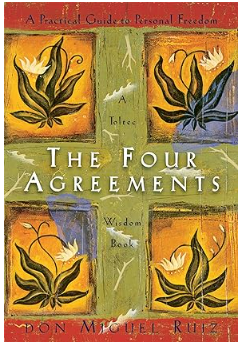
  • The Four Agreements — Don Miguel Ruiz

    The Four Agreements — Don Miguel Ruiz

    The Four Agreements introduces the idea that many of our beliefs began as someone else’s opinions. Parents, teachers, religious leaders, and others teach us how life is supposed to work long before we can distinguish opinion from fact. As we adopt these ideas as beliefs, we make agreements with them. But what happens when an agreement no longer serves us? Can we change it? Absolutely. Drawing from the Toltec tradition, Don Miguel Ruiz suggests replacing limiting beliefs with four agreements: Be impeccable with your word. Don’t take anything personally. Don’t make assumptions. Always do your best.

    I recommend this book to anyone interested in understanding how their beliefs developed and how those beliefs influence their daily experiences. It offers a practical way to examine the assumptions we’ve carried through life, question what we’ve accepted as truth, and begin choosing beliefs that support greater peace and personal growth.

    I first read this book in 2017, and it changed the direction of my life. The second agreement, don’t take anything personally, had the greatest impact. I remember leaving my office the day I read it and waiting in my truck to turn onto the road. As another truck passed, I made eye contact with a young man in the passenger seat. He was laughing. Immediately, I became defensive. What’s he laughing at?! As I drove toward the stoplight, I imagined all sorts of reasons this guy might be laughing at me and what I’d say if I confronted him. Then, suddenly, I remembered: Don’t take anything personally. My anger dissolved, I laughed at myself, and said, “Now I get it!” I had observed something, invented a story about it, and made myself angry over a situation I knew almost nothing about. He might have been laughing at me, but why assume that? And even if he was, why make it my problem? By letting go of that anger, I also avoided carrying it home to my family.

    Since then, I’ve recommended this book to countless people and given away dozens of copies. Not everyone connects with it, and I’ve learned that’s perfectly fine. We’re all traveling our own paths, and what changes one person’s life may mean nothing to another. But for those who are ready to question their agreements, this little book might open the door to an entirely different experience of life. And if it doesn’t, that’s great, too.

    A few years ago I made this 8-bar song based on The Four Agreements as part of a challenge issued by YouTube personality Pete Johns.

  • Understanding Experience: Resistance Is a Teacher

    Sometimes we spend more time arguing with what happened than deciding what to do now.

    We replay a conversation. We insist something shouldn’t have happened. We tell ourselves we shouldn’t feel the way we feel.

    Then we become frustrated with ourselves for being frustrated.

    What if those moments could teach us something?

    Life is the sum of its parts

    Consider a simple equation:

    2 + 2 + 2 = 6

    Change one of the numbers:

    2 + 2 + 4 = 8

    Neither answer is good or bad. Each is the complete result of the numbers that went into it.

    Life works similarly. This moment is the culmination of what has happened leading up to it. Some of those things were our decisions. Others occurred outside our control.

    When I describe the present moment as perfect, this is what I mean: complete or whole. The sum of the parts.

    I don’t mean that everything that happened was good, fair, or desirable.

    Whatever happened, here we are.

    We cannot change the equation that brought us to this moment. We can decide what to contribute to the next one.

    What we bring to an experience

    Our experiences contribute to the development of preferences, beliefs, expectations, and habits.

    We learn what we enjoy, what we fear, and how we think people should behave.

    Sometimes a preference becomes an expectation. “I would like this to happen” becomes “This should happen.”

    Imagine planning an outdoor activity because you enjoy sunshine. Then it rains.

    The rain is an event. Your disappointment reflects, in part, the difference between what happened and what you wanted.

    Someone else might welcome the same rain.

    Same weather. Different experiences.

    This gives us something to explore: what happened, and what did I bring to it?

    Feelings are not instructions

    When something happens, your body may react before you consciously understand why.

    Your muscles tighten. Your heart races. You feel heat, fear, anger, or an urge to escape.

    These initial reactions aren’t necessarily chosen.

    But a feeling and an action are different things.

    You can feel anger without yelling. You can experience an urge without immediately following it.

    Awareness begins when we notice the distinction between the event, our interpretation, our feelings, and what we do next.

    Resistance is a teacher

    Imagine running your hand across a piece of wood.

    You feel a rough spot. The friction tells you where attention may be useful.

    You don’t need to become angry with the wood. You have discovered something about what you’re working with.

    Resistance can serve a similar purpose.

    Here, I’m using resistance to mean fighting the reality of what has happened: insisting that it should have been different, or that we cannot work with an experience until it changes.

    Fear itself isn’t necessarily resistance. If you encounter danger, recognizing it and protecting yourself can be an expression of acceptance.

    Acceptance does not require standing still.

    But when we notice ourselves arguing with reality, we can become curious.

    What expectation is involved? What belief feels threatened? What am I demanding from this moment?

    Resistance isn’t bad. It is information.

    Awareness comes before acceptance

    Perhaps you spend two days replaying an argument before recognizing what you’re doing.

    That recognition matters.

    You haven’t failed because you didn’t notice sooner. You have become aware now.

    Next time, you might notice after a few hours. Another time, you might recognize the pattern while it is happening. Difficult circumstances may make it harder again.

    There is no required schedule.

    Awareness of resistance is the beginning of acceptance. You can acknowledge:

    “This is what I’m experiencing right now.”

    You don’t have to understand, approve of, or agree with what happened to accept that it happened.

    You don’t even have to make the resistance disappear.

    Acceptance leaves room for action

    Suppose Tom yells at Mark.

    Mark feels angry and thinks, “He’s disrespecting me!”

    Mark yells back. Tom responds. Each reaction becomes the other person’s next experience.

    Another possibility is that Mark notices his anger and says, “I can talk when we’re both calmer.”

    He might leave or establish a firm boundary.

    Tom’s next response is still up to Tom.

    Mark can choose his contribution without controlling the outcome.

    Even leaving can happen from different internal places. Mark might leave and continue arguing in his head for hours. Or he might leave while acknowledging his anger and allowing himself to experience it.

    And if he notices the mental argument hours later, that is another opportunity to practice.

    Pain and the struggle we add

    Pain and suffering can mean different things to different people.

    In this framework, I use suffering to describe the additional struggle that can arise when we resist an experience.

    “This hurts” acknowledges pain.

    “This shouldn’t be happening” may add an argument with reality.

    Acceptance may soften that additional struggle without removing the pain. Grief can remain. Physical discomfort can remain. We can still need care, support, or help.

    This distinction is an invitation to notice our relationship with pain, not a reason to blame ourselves for being distressed.

    Refinement has no deadline

    A woodworker might begin with 80-grit sandpaper, then move to 120, 180, or something finer.

    The existence of 3000-grit sandpaper doesn’t make the work done with 80 grit worthless.

    Each stage has value.

    The analogy describes a process of refinement, not a ranking of people.

    Learning something at ninety still matters. Learning it at twenty may give us more years to benefit from it. Neither requires turning growth into a race.

    We work with what we notice.

    Don’t resist your resistance

    There is an easy trap here.

    We learn about acceptance, then decide we should be accepting. When we notice resistance, we criticize ourselves.

    Now we’re resisting our resistance.

    If that happens, notice it.

    Now you’re aware of something else.

    Resistance is not evidence that the practice has failed. Resistance is an opportunity to practice.

    Start with a few questions:

    • What happened?
    • What am I experiencing?
    • What am I resisting?
    • Can I allow this experience to be what it is, including the resistance?
    • What can I do now?

    Notice what is happening. Allow yourself to experience it. Learn what you can.

    Then return to living your life.


    For a printable companion to these ideas, download my free guide, Understanding Experience, from the Resources page at ImagineMovingOn.com.

    If you would like to explore these topics further, contact Paul Brodie at paul@imaginemovingon.com to discuss a coaching session.

  • Another Way to Consider the Lilies

    I found myself contemplating a flower and realized I was only seeing it from one angle.

    Jesus told me to consider the lilies of the field and to take no thought for tomorrow.

    I wondered if this meant I shouldn’t worry about working. If the flowers are beautiful without toiling, then why should I toil?

    Then Lao Tzu told me to act without forcing. I realized Jesus wasn’t telling me to do nothing. He was telling me something about the measure of creation. The flower does what is within it to do. Nothing more is required.

    Eckhart Tolle suggested that the flower doesn’t worry about where it came from or where it is going. It doesn’t dwell on its experience as a seed or fear its inevitable return to the soil as food for insects and fungi. It simply exists as the flower it is now.

    I began to see more than the flower I had originally been looking at.

    Don Miguel Ruiz reminded me that the flower doesn’t exist alone. There are many other elements at play: soil, water, sunlight, insects, weather. The flower lives in relationship with all of them, but it doesn’t need to make any of them into something they are not, nor mistake any of them for what it is. The flower is still the flower. 

    In the midst of all this pondering, I heard Michael Singer ask:

    “But who is noticing the flower?”

    Ah.

    I am not the flower. I am aware of the flower.

    The flower doesn’t need to become anything other than what it is, yet everything that needs to be done is accomplished. It contents itself with being a flower. It doesn’t dwell on its earlier stages of development or fear what comes next. It participates with its environment without needing to control it.

    Once again, I consider the lilies of the field.

    Now, with a fuller view, I fall deeper into contemplation—until another voice pulls me back.

    Alan Watts asks:

    “After all of this philosophy and contemplation, have you ever taken the time to stop and just smell the damn thing?!”