Category: Philosophy & Meaning

  • Who Created My Enemies?

    For as long as I can recall, I’ve been investigating the nature of life, particularly the relationship between the physical body and spirit. Through my former religious belief system, I was taught that the natural man is an enemy to God and must put off his natural desires and submit himself to God in order to be saved.

    I was also taught that my spirit existed before I was born and brought experience and understanding with it when it entered my physical body. The physical world was a temporary place for the spirit to learn and grow before eventually returning to God.

    This created an interesting relationship between the physical and spiritual parts of myself. My spirit was eternal, divine, and something to nurture. My physical body was temporary, prone to temptation, and something to overcome.

    In other words, part of me was the enemy.

    I’ve since abandoned Mormonism and many of the beliefs associated with it, but some elements of its understanding of spirit have stuck with me. When I stopped believing in that religious framework, I began exploring other ideas. I’ve always been seeking understanding, although what was once a quest for absolute truth has relaxed into a pursuit of observation.

    I still hold beliefs, and I attach lightly to some of them. When I discover a deeper attachment, I work on relaxing it. One truth I’ve settled on is that I don’t know the answers to most of my questions, and I probably won’t during this lifetime.

    I’m okay with that.

    You might wonder why I continue asking questions if I don’t expect to find definitive answers. That’s a fair question. For one thing, I’m not certain there aren’t definitive answers. Perhaps one day there will be sufficient evidence for me to confidently answer some of these questions. In the meantime, I see no harm in exploring. If I stop asking questions, how will I recognize an answer if one becomes available?

    So I ask, and I observe.

    Who Is the Enemy?

    As my understanding of spirituality changed, so did my understanding of the self.

    For a while, I became interested in the distinction between the ego and the authentic self. I understood the ego as the identity associated with my physical body, including its thoughts, emotions, preferences, and conditioned responses. The authentic self was something deeper, perhaps the spirit itself.

    My goal was to eliminate the ego and live entirely from that authentic self.

    Kill the ego!

    But looking back, I wonder if I had simply replaced one enemy with another.

    I was no longer trying to overcome the natural man to please God. I was trying to overcome the ego to become my authentic self. The terminology had changed, but the relationship was remarkably similar. I still believed there was a part of myself that needed to be defeated before I could experience life as I ought to.

    Somewhere in my phone I have a notebook entry containing a single question:

    If God created you, then who created your enemies?

    I don’t remember exactly what prompted me to write it, but I find it interesting in this context. If I believe God created my body, including its natural tendencies and limitations, why would I consider that creation an enemy? And if I no longer believe in that explanation of God, why would I continue treating aspects of myself as adversaries?

    Perhaps the problem isn’t the existence of the ego or the physical body. Perhaps it’s the relationship I’ve developed with them.

    The Submarine

    Here’s an idea I’ve been exploring.

    Suppose I want to investigate the deepest parts of the ocean. My physical body isn’t suited to that environment. I can’t breathe underwater, withstand the pressure, or survive the cold temperatures. If I try to explore those depths with my body alone, I’ll suffocate, freeze, or be crushed.

    I need a vehicle capable of supporting life in that environment.

    I need a submarine.

    The submarine allows me to experience a realm that would otherwise be inaccessible to me. I’m still limited by the capabilities of the vessel, but I can now explore a world I couldn’t experience firsthand without it.

    Now consider the possibility that something similar is happening between the physical body and spirit.

    What if a spirit exists in a spiritual realm and wants to experience the physical world? Perhaps, for reasons I don’t understand (spirit physics?), it cannot directly interact with this environment.

    Could the physical body be the equivalent of a submarine? A vehicle that allows a spirit to enter and experience a realm it otherwise couldn’t?

    I don’t know. It’s entirely speculative.

    I don’t know whether spirits exist independently of physical bodies, whether they existed before birth, or whether they continue after death. But I find the possibility interesting, and I don’t think I need to establish its truth to benefit from considering it.

    Because if my body is the submarine, why would I treat it as an enemy?

    An Autonomous Vehicle

    Something else I’ve been considering is just how much my physical body does without any conscious direction from me.

    I don’t have to remind my heart to beat or my lungs to breathe. I can consciously influence my breathing, but most of the time it continues without my attention.

    If I break a bone, I don’t consciously instruct the cells to repair it. If I cut my finger, I don’t have to develop a healing plan and supervise the reconstruction. My body knows what to do.

    I don’t have the slightest idea how to generate a new liver cell, but my body manages that process without consulting me.

    Even eating is interesting. I think I decide when and what to eat. I can choose to prepare a meal, put food in my mouth, chew, and swallow. But from that point forward, I have very little conscious participation in what happens. My body takes over, breaking down the food, absorbing nutrients, distributing energy, and disposing of what it doesn’t need.

    I’m not doing any of that intentionally. At least, not that I’m aware of.

    The body is a remarkable collaboration of trillions of cells, maintaining a complex biological system that largely operates without conscious supervision.

    So who’s actually operating this thing?

    Sometimes I think of the body as an autonomous vehicle, with consciousness as its passenger. Other times, perhaps I’m the co-pilot. There are certainly things I seem capable of directing, although even the origin of those decisions is worth questioning.

    I don’t generally plan my thoughts before they appear. I become aware of them. And then I may respond to them with additional thoughts, which also seem to appear without much advance notice.

    Is there a separate observer experiencing these processes? Is that what I mean when I refer to spirit or authentic self? Or is the observer simply another function of the biological system?

    I don’t know.

    And the more I explore the question, the less certain I become that I need to divide the experience into separate identities at all.

    Integration Rather Than Opposition

    When I was religious, I believed the natural man needed to be overcome. Later, I believed the ego needed to be eliminated.

    Now I’m more interested in integration.

    Instead of treating the body and ego as adversaries, I’m considering them as parts of the experience of being human. My body has biological needs, preferences, and protective responses. My ego has developed through experiences, relationships, learning, and conditioning.

    Perhaps these aren’t obstacles standing between me and my authentic self. Perhaps they’re essential components of the experience I’m having.

    If the physical body really is a vehicle for spiritual exploration, then its limitations and characteristics are part of how that exploration occurs.

    And if there is no separate spirit, if consciousness is entirely a product of the physical body, then those same processes are still worthy of understanding and acceptance.

    Either way, I don’t see much benefit in declaring war on them.

    This doesn’t mean I need to obey every impulse or satisfy every preference. The body can experience hunger without requiring me to eat immediately. I can notice fear without automatically retreating. I can experience anger without acting aggressively.

    I can observe these experiences, consider their significance, and respond as appropriately as I’m able.

    That’s different from trying to eliminate them.

    I don’t have to destroy the ego to recognize its influence. I don’t have to overcome the body to appreciate what it allows me to experience.

    Perhaps the goal isn’t to remove parts of myself until only the authentic self remains. Perhaps it’s to develop awareness of the whole experience and learn to work with it.

    Still Exploring

    When I began writing this article, I intended to share a metaphor about how the physical body might allow a spirit to experience the physical realm.

    I thought the submarine illustrated the idea rather nicely.

    But as I explored it, more questions emerged. Is the spirit the pilot, the co-pilot, or simply a passenger? Is the body entirely autonomous? Is there an authentic self independent of the ego? Is there even a spirit aboard the submarine?

    Who knows?

    I started with an idea that I thought might explain something, and I ended up with more questions than answers. That’s not unusual for me anymore.

    What has changed is that I no longer feel compelled to settle on an explanation.

    I used to believe I needed to conquer the natural man. Then I thought I needed to kill the ego. Now I’m wondering whether there was ever an enemy to begin with.

    I don’t know whether the body is a submarine for a spirit or whether the body itself produces the consciousness that wonders about such things.

    What I do know is that I’m here, experiencing life through this remarkable physical body. Whatever the explanation for my existence, perhaps I can appreciate the vehicle, observe its workings, respond to its needs, and explore the experience rather than fight against it.

    Maybe I don’t need to defeat anything to be myself.

    And if it turns out we’re all living in a yellow submarine, at least I’ve already got the song stuck in my head.
  • As a Branch Letting Go of Its Leaves

    As a Branch Letting Go of Its Leaves

    Learn from it. Let it go. Repeat.

    I once had a girlfriend, but then one day she dumped me.

    That’s a line from a song by The Vandals. It’s also an experience I had in 2009. She dumped me, and I became very depressed. The bright side is that I wrote a couple of songs about the experience. One of them is called As a Branch Letting Go of Its Leaves, and that song came to mind recently while I was contemplating letting go and moving on.

    At the time, I was taking things personally and living as though my preferences for reality were something that should be pursued, or even enforced. Hence the misery I felt when I didn’t get what I wanted.

    I’m sure the 2009 version of myself would have said that she made me sad. But is that really what happened?

    She didn’t make me feel anything. She expressed her preference for our relationship, which resulted in a change in my circumstances. That change no longer matched my preference, so I felt pain and sadness. And that’s appropriate. Losing something meaningful hurts.

    But I resisted that pain because I didn’t like it, and that’s when my pain and sadness turned into suffering.

    She didn’t make me suffer. My resistance did.

    It’s easier to see in retrospect.

    My resistance came in the form of hoping she would change her mind and wishing things were different than they were. It’s akin to yelling at the sky when it’s raining on the day I planned to have a picnic. I can yell myself hoarse, but I can’t change the rain.

    Wanting the rain to stop isn’t necessarily a problem. Neither is wanting a relationship to continue. The trouble begins when I can’t accept that reality isn’t cooperating with my preferences.

    Looking back, did I really want her to go against her own preferences to satisfy mine? On some level, yes. But if I give it honest consideration, of course not. Nothing good comes from imposing your will on someone else.

    I was deeply attached to my preference, and the depth of that attachment was likely connected to my own insecurity. That’s a whole other trail to follow another day.

    In my sadness, I wrote a song using the metaphor of a tree dropping its leaves in autumn to represent how I wanted to let go of my sadness. It was September when she dumped me, and I held onto that suffering well into the winter. I don’t recall exactly when I wrote the song.

    It’s interesting to consider my old lyrics through the lens of my current understanding and awareness. They take on more meaning to me now, without diminishing the meaning they held for me then.

    But this isn’t all about nostalgia. I have a simple thought to share about trees.

    The Tree and Its Leaves

    Recently, while contemplating letting go of whatever no longer serves me—resisted energy, limiting beliefs, or whatever else I might be carrying—my old song came to mind.

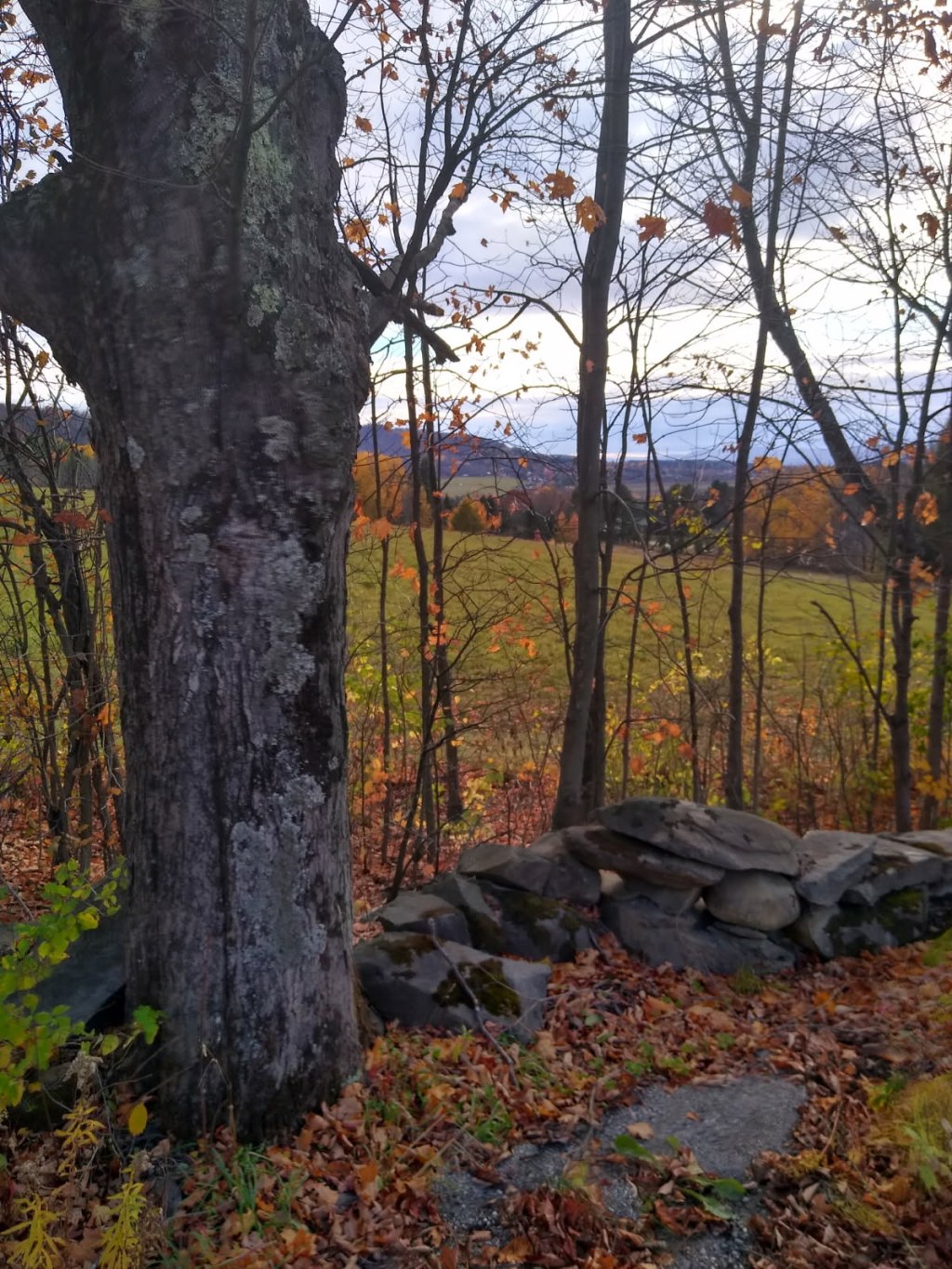
    I pictured a massive tree standing alone in a field. Some leaves were already on the ground, some were drifting away on the wind, and others remained attached to the branches.

    Can you picture it?

    A warning before we continue: I’m not an arborist, and what follows isn’t intended to be a scientific explanation of trees. The symbolism isn’t to scale. It’s cartoonishly illustrative. Bear with me.

    Looking at this imaginary tree, I wondered: What happens when a tree holds onto its leaves past their time?

    I’m not suggesting a tree does this willfully, but I’m not saying it doesn’t either. I’m not the boss of the trees.

    I live in Vermont, where most deciduous trees drop their leaves in autumn. The evergreens, of course, do their own thing.

    Imagine a tree that doesn’t release its leaves as winter approaches. When the snow and ice arrive, those leaves provide additional surfaces for accumulation and resistance to the wind. Under the right conditions, that extra burden could contribute to branches breaking.

    The leaves that once served the tree during its season of growth have become something it would be better off releasing.

    I think we do something similar.

    We hold onto experiences, expectations, beliefs, and emotional reactions long after the circumstances that produced them have passed. What once seemed important, meaningful, or even necessary can become a burden when we refuse to let it go.

    When my girlfriend ended our relationship, she was, in essence, telling me it was time for a new season. But I didn’t want a new season. I wanted to stay in the one I was enjoying.

    And so I resisted.

    The relationship had ended, but I continued trying to live in it through my thoughts, hopes, and expectations. I couldn’t change what had happened, but I could keep wishing it hadn’t happened. And I did.

    It hurt to lose the relationship, and that’s okay. What I didn’t understand at the time was that I could allow myself to feel that hurt without trying to change the circumstances that caused it.

    Perhaps it hurts a leaf to fall from a tree. If we anthropomorphize the leaf, I imagine the experience would be terrifying. One moment it’s securely attached to a branch, and the next it’s drifting toward an uncertain future.

    But nature says it’s time to go.

    What Falls Away Can Still Serve Us

    There’s another part of this metaphor that I find particularly meaningful.

    When a tree drops its leaves, they don’t simply disappear. They fall to the ground, where they gradually decompose and contribute nutrients to the surrounding ecosystem. That ecosystem, in turn, supports the tree’s future growth.

    The leaves have served their purpose in one season, but they still have something to contribute to the next.

    Perhaps our experiences work similarly.

    If I continue clinging to an experience, wishing it were different or trying to preserve something that has already passed, I may prevent myself from fully appreciating what that experience has to teach me.

    My relationship in 2009 didn’t continue the way I wanted it to. That was painful. But the experience also gave me opportunities to learn about attachment, insecurity, personal preferences, and the difference between pain and suffering.

    I couldn’t appreciate all of that at the time. I was too busy wishing things were different.

    Now, many years later, I can look back on the experience without the same emotional burden. I can remember the relationship, appreciate what it meant to me, recognize what I learned, and even enjoy the songs I wrote because of it.

    The experience hasn’t changed. My relationship with it has.

    That’s what I mean by letting go.

    Letting Go Isn’t Forgetting

    Letting go doesn’t mean forgetting what happened, pretending it didn’t matter, or denying the emotions that accompanied it.

    We’re talking about releasing our resistance to the experience, not erasing the experience itself.

    Memories can remain without requiring us to relive the emotional struggle that once accompanied them. We can remember being hurt without continuing to fight the circumstances that hurt us.

    The tree doesn’t need to hold onto last autumn’s leaves to benefit from them. Their contribution becomes part of the environment in which the tree continues to grow.

    Likewise, I don’t need to hold onto the suffering associated with my past to benefit from what I’ve learned.

    And perhaps that’s the part of my old song that means the most to me now.

    In 2009, I wanted to let go because I didn’t want to hurt anymore. Today, I see letting go as something more than an escape from pain. It’s a willingness to experience life as it unfolds, to allow things to change, and to recognize that something can be meaningful without needing to last forever.

    The tree doesn’t stop growing because it loses its leaves. Losing its leaves is part of how it continues growing.

    And when another season comes, it grows new ones.

    Learn from it. Let it go. Repeat.

  • Like a Movie…

    You just saw a movie preview and it looks great! It’s a story that you are familiar with, has actors you like, and you expect it will be an instant favorite. You immediately pre-order a ticket and arrange your schedule to attend the premiere. You arrive early, buy the snacks, and find a seat. As you wait for the previews to start, the theater is playing commercials for trucks and pharmaceuticals. When did theaters start showing commercials before a movie? That’s annoying. You contemplate how much you just spent on popcorn and a soda. That’s annoying. The previews begin and the speaker on the wall just above your head seems to buzz on the deep bass sounds. That’s annoying!

    Eventually the movie begins and you seem to relax a little. Your excitement comes back, drowning out the minor frustrations you’ve been noticing. A few minutes in and one of the characters comes into the scene but they don’t look or act how you imagined them based on your familiarity with the story. Perhaps it was a book you read. Soon you notice they skip over what you thought was an integral scene for the story. Movies do that sometimes. That’s annoying. It begins again. By the end of the movie you aren’t sure if you enjoyed it or not. That’s not what I expected.

    I think whether or not you enjoyed the movie depends on your level of attachment to your preference. Throughout life we have experiences and form preferences based on those experiences. Subsequent experiences reinforce or adapt our preferences. From Buddhism we hear that the cause of suffering is desire (preference). Does that suggest it is wrong to have preference? I think we can understand the concept without altering the message by adding in the element of attachment to preference. It’s the difference between saying “I want this to happen because I like it” and “I need this to happen in order to be okay.” Attachment in this context means making my sense of well-being conditional upon having a preference met. I think this attachment to preference is the cause of suffering.

    Listening to Michael Singer’s podcast lectures over the last few months I’ve been presented with a story I became familiar with through my earlier life as a practicing Christian. In Luke 22:42 Jesus is praying in Gethsemane, about to take upon himself the troubles of all people in order to atone for them. He says, “Father, if thou be willing, remove this cup from me: nevertheless not my will, but thine, be done.” I used to understand this as Jesus submitting his will to the will of God, but with Singer’s perspective I now see it as an analogy for living life without resistance.

    Jesus starts his prayer with a preference: remove this cup. He then concludes by accepting whatever will come, regardless of his preference. It seems that while Jesus had a preference, he was not attached to it. He could anticipate what was coming without insisting that it unfold differently. He was able to meet reality without resisting it.  After this prayer he was arrested, brought before the rulers to be judged, and ultimately was killed. For the purpose of this article, I’m looking at this story symbolically.

    It is not bad to have preference. It is not bad to have expectations. It is not bad to have expectations born from attached preference, although this might be the recipe for suffering. A movie hit streaming a few months ago that I had heard mostly bad reviews about. I was indifferent to or unfamiliar with the cast. I find the director to be overrated. But the topic of the movie was very interesting. Based on my experiences and preferences, I expected to dislike the movie. One weekend afternoon with nothing to do I put the movie on. I planned to turn it off if it didn’t immediately hook my attention. When the movie ended I wanted more. I thoroughly enjoyed it, in spite of my expectations. I think this is because I wasn’t attached to the preferences that led to my expectation. I didn’t have a high opinion of the director, but could they still make a good movie? Sure. I didn’t know the actors, but could they be great? Sure. People on the internet are saying the movie isn’t any good, but can people on the internet have some wonky opinions? Case in point…

    Let go of your expectations, especially the ones that are based upon your preferences if you are feeling like you need them to be met. Wonky opinion? Perhaps, but give it a try. Practice letting reality be what it is. Practice allowing the universe or God or whatever your belief is to unfold before you. Personally, I believe my spirit entered this life for a purpose. I don’t know what that purpose is, but I think it has to do with growth. I believe that a direction was chosen and a gentle push was applied. All I needed to do was to go with the flow, but I didn’t know. I lacked the wisdom to see how painful experiences could be for my benefit, and I developed preferences to protect what I thought needed to be protected. This resulted in me resisting life, holding on to past experiences, afraid to let them go.

    Surrendering to life or submitting to God’s will doesn’t mean becoming a victim of reality, it means responding to reality. It means accepting that things won’t always match your preference or expectation, so hold them lightly. Experience life as it is and respond to what happens, rather than demand that it be what you want and react when things go askew.  It’s okay to like or dislike a movie. It’s okay to expect a movie to be good or bad. It’s okay to suffer. But if you don’t want to suffer, if you prefer to experience peace, it’s also okay to relax your attachments to preference and release your expectations for reality to be the way you want it to be.

  • Is Karma My Judge or My Teacher?

    I grew up in New Jersey and as a member of The Church of Jesus Christ of Latter-day Saints (Mormonism). I no longer live in NJ and I’m no longer a participant in that faith. Life changes. My point in bringing these origin points up is that neither one directly lends to the teaching or understanding of karma, which means my understanding of karma is primarily drawn from movies, television, books, and music. More recently, I’ve learned how karma appears in several religious and philosophical traditions with differing interpretations. I’m not breaking new ground regarding karma, I’m simply exploring my own understanding.

    I’m sure one of my earliest experiences with karma was learned through The Simpsons. Much of what I’ve learned in life between December 1989 and the early 2000’s came that way. I’m not ashamed. Based on my pop-culture understanding, karma was a form of judgment: punishment or reward for past behavior. “Karma will catch up with you eventually.” That sort of thing. A variation of the Golden Rule, or perhaps the result of it. And this approach always made sense to me as explained, and could serve as a guide. If I feel anger and want to take it out on someone, I might remember that karma will repay me in kind for whatever I dish out. And then perhaps I decide against lashing out in anger. And this is where today’s understanding of karma comes in.

    What if karma is a teacher instead of a judge? It’s not that my actions generate punishment, but that my actions might reveal a lesson I haven’t yet learned.  And sometimes the hardest times are the greatest teachers. Why is this challenge showing up in my life? Let’s imagine I was rude to a clerk in the store last week. Today I am facing a challenge communicating with someone else. Is this a punishment for my past behavior, or did my past behavior indicate an area I may need further instruction in and now life is presenting this opportunity? Whether through spiritual influence or because of my own awareness.

    Karma as judgment: I did something wrong, and now something unpleasant must happen to me because of it.

    Karma as education: I did something that revealed something about myself that I might benefit from understanding.

    A friend of mine described karma as a relationship. I wish I could recall more about that angle, but I’ve since lost it, that’s the only part that remains. Since it comes to mind now, I’ll wonder if maybe it’s because karma is a relationship between me—the physical, ego-directed self—and the universe—or God, my authentic self, or soul. I’m not certain of the details, but I believe that life serves a purpose for spiritual growth and within this purpose there are seasons for learning and seasons for proving. Just like in school there are units of education followed by a test. Failing a test often leads to revisiting the material and new testing. Could this be how karma operates?

    Sometimes an idea comes to center stage and demands my attention. When that happens, I try to consider it, whether from a new perspective or an old understanding. I wonder why it’s showing up now. It doesn’t have to mean anything, but I’ll consider if it does. Today, I’m considering whether I want to see karma as my judge or my teacher.

  • Let the Snowman Melt

    Let the Snowman Melt

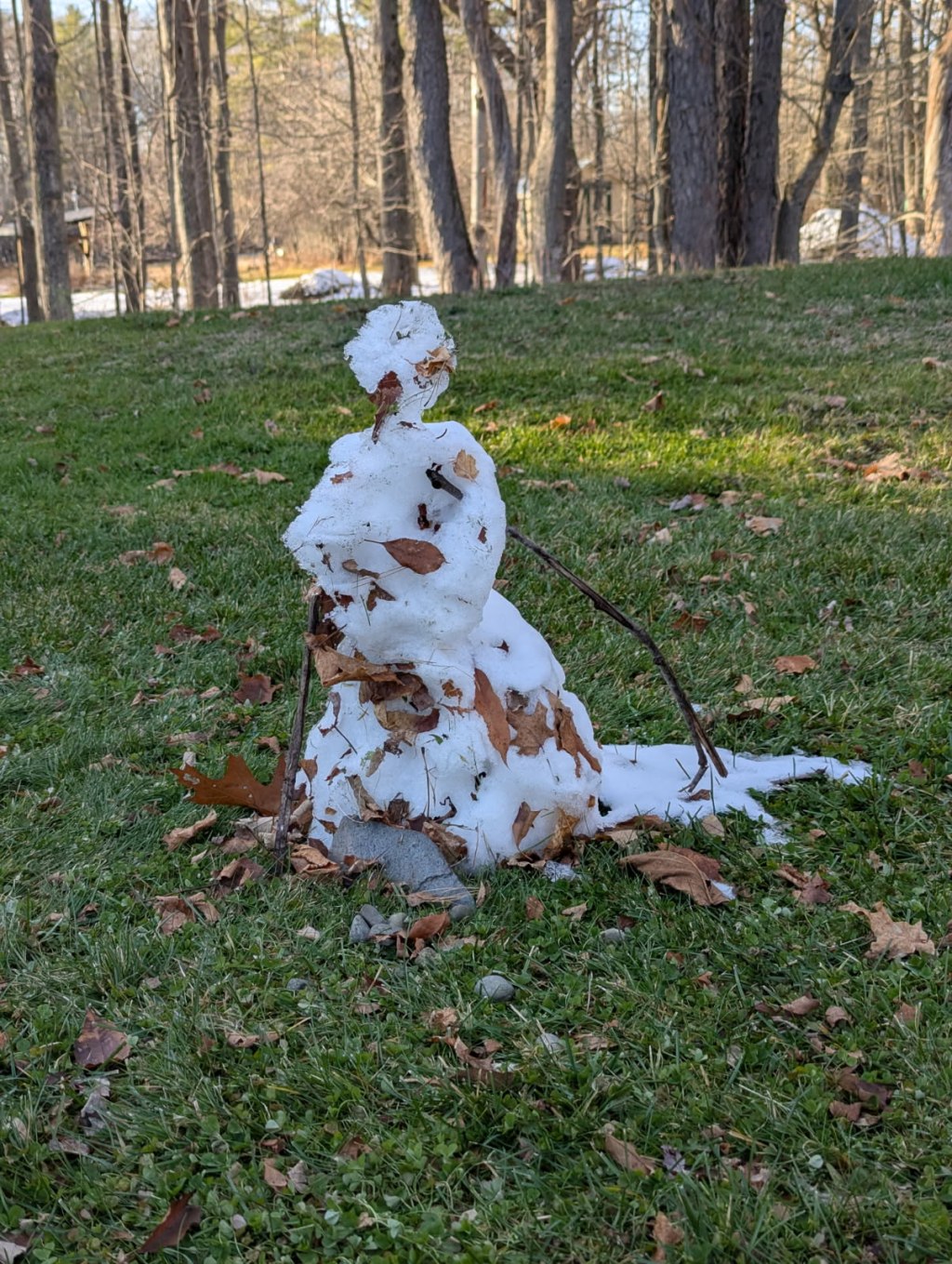
    A few days ago I sent out a request for photos of nature to my family. In starting this blog, I thought it would be nice to have a library of photos I could use to accompany posts when appropriate. One of the photos my mom sent was of a sickly looking snowman on green grass. She told me my children made it. I assume it’s from an early snow in a recent year. Just enough snow to roll up, leaving the yard looking bare. This is the image accompanying this post, likely taken toward the end of the snowman’s existence, given his deteriorating state, which could have been as soon as the same day of his creation.

    Exploring a dream image I experienced a few nights ago, which was recalled when seeing a lock-screen image of the Bisti Wilderness in New Mexico, I found myself exploring erosion, chimneys, and hoodoos. And that is what brought the snowman photo back to my mind, encouraging the following exploration of thoughts.

    But first, let’s look at the snowman.

    It’s freezing cold and the clouds are heavy. Snow falls. Individual flakes accumulate like sand on a beach to the point that it looks like one entity instead of an infinite number of finite entities amassed. The individual snowflakes are rolled together to form the different-sized snowballs that will make the snowman’s body.

    The process is usually filled with laughter and joy. People united in purpose, working to create something fun and beautiful. Adorned with stick arms, rock buttons and eyes, maybe even a carrot for a nose, the joy culminates as the extra knitted hat and scarf are applied to the snowman.

    This snowman is early, though.

    The temperature rises. The clouds part ways. The sun warms the snow and the snowman dissolves, slowly. The fullness that brought happiness melts into a sickly shell of its former grandeur. The builders or other onlookers lament the passage of glory from the once-rotund snowman to whatever this is, with drooping stick arms and falling rock buttons. It looks at you with one eye remaining next to a stained snow empty socket.

    Then the carrot falls.

    Sadness replaces the laughter as the snowman falls from grace. Eventually all that’s left is a wet spot of grass with sticks, stones, and knitted wool lying haphazardly.

    But wait.

    Who said the snowman fell from grace?

    Nothing has gone wrong. The temperature changed. Frozen water became liquid water. The conditions that allowed the snow to fall, accumulate, and become a snowman continued to change, just as they had been changing all along. We are the ones who picked one frame from that process and declared, There! That’s the snowman.

    We don’t usually mourn the individual snowflakes as they’re crushed together into a ball. We call that creation. We don’t lament the loss of three perfectly good snowballs when they’re stacked on top of each other. We’re making something! 

    Then we press the final rock into his face, wrap the scarf around his neck, stand back and admire our creation. He’s done. Or is he?.

    We’re done building him.

    The snowman is still changing. He was changing while we rolled him. He was changing when we put on his scarf. He was changing when we took his picture. He was changing while we stood there admiring him. There was never a completed snowman followed by a deteriorating snowman.There was only a snowman that was new every moment. We just preferred some of those moments to others. And there’s nothing wrong with that.

    This isn’t an exercise in convincing yourself that the pathetic melting snowman is every bit as beautiful as the glorious rotund snowman from an hour earlier. You are allowed to prefer one condition over another. You’re allowed to feel joy when the snow starts falling. You’re allowed to laugh while building the snowman. You’re allowed to admire him when he’s finished.

    And you’re allowed to feel sad when he melts. Sadness isn’t the problem. The trouble begins when preference becomes resistance. I wish the snowman hadn’t melted is a preference. The snowman shouldn’t have melted. Why did this have to happen? This isn’t fair. I wanted him to stay the way he was is an argument with reality. And reality doesn’t care. The snowman is melting. So let the snowman melt.

    That doesn’t mean make the snowman melt. It doesn’t mean want the snowman to melt. It doesn’t mean pretend that you like the melted version as much as the freshly built one. It means let him melt because he is melting. If you really want to preserve him and you happen to own a walk-in freezer, reality has given you something to do. Go get the snowman. But if all that’s left is a scarf lying next to a puddle, demanding yesterday’s snowman from today’s weather isn’t going to bring him back. It only creates resistance to what is.

    This is where the hoodoos that led me back to the snowman become interesting. A hoodoo is a tall, narrow geological formation created through erosion. Harder material at the top can protect the softer material underneath while the surrounding material erodes away. Eventually an incredible formation is left standing. But it’s temporary.

    The erosion that created the hoodoo is still happening. Eventually the cap will fall. The pillar will collapse. Given enough time, the remarkable formation that someone might travel across the country to see will disappear. 

    So when exactly is the hoodoo finished? The process that will eventually destroy it is the same process that created it. Maybe creation and destruction are just names we give to different directions of change based on whether we like what is happening. The same is true of the snowman. Snow accumulates and we call it creation. Snow melts and we call it destruction. But the water doesn’t care. It’s just changing.

    And this brings me to a word I’ve been thinking about lately: ecstasy. I’ve been listening to Michael Singer, who frequently talks about living in a state of ecstasy. I’ve always struggled a little with that word because I associate ecstasy with bliss. An extreme positive emotional state. But I’ve started assigning a different meaning to it.

    What if ecstasy isn’t an abundance of pleasant experience? What if ecstasy is an abundance of experience without resistance? Maybe sadness isn’t the opposite of ecstasy. Maybe resistance is.

    When I was younger, I wanted to win when I played sports or games. Winning was where the joy was. Or perhaps what I thought was joy was sometimes just the relief of not losing. As I’ve gotten older, I’ve discovered that I can enjoy playing without needing to win. I still play to win. That’s part of playing the game. Winning feels good. Losing can be disappointing. I might be frustrated when I strike out or laugh when something goes spectacularly wrong.

    But the joy is no longer dependent on the outcome. The joy is in playing.

    A video game can be fun when I’m defeating the bad guy and it can be fun when the bad guy absolutely destroys me. I don’t have to enjoy those outcomes equally. I can yell at the screen when I lose. I’m still having the experience. Maybe life can be approached the same way.

    If I’m happy, I get to experience happiness. If I’m sad, I get to experience sadness. If I’m excited, afraid, disappointed, angry, peaceful, confused, or filled with grief, I get to experience those too. Sadness is energy. Happiness is energy. Fear is energy. Life is experienced through all of it. Maybe ecstasy isn’t feeling good all the time. Maybe ecstasy is being open to the experience that is actually happening.

    That doesn’t mean I don’t get lost in sadness. It means I don’t have to lose myself in sadness.

    And it certainly doesn’t mean I need to become happy about being sad. That would just be another form of resistance. Now instead of demanding that reality be different, I’m demanding that my emotional response to reality be different. It’s not that I shouldn’t feel sad. I do at times. And I let that happen too.

    Be grateful for joy when joy is present. Be grateful for sadness when sadness is present. Not because sadness is secretly good, but because it is part of the experience of being alive.

    Whatever is present, is.

    Maybe that’s the whole point of all of this.

    Experience what is, when it is.

    Frame by frame.

    The newly fallen snow. The first snowball. The laughter. The carrot. The magnificent finished snowman. The first drip of water. The crooked head. The missing eye. The fallen carrot. The sadness. The puddle. The wet grass.

    We don’t have to decide that every frame is equally preferable. We just don’t have to demand that the movie stop on our favorite one. If you love the snowman, you might want to preserve him. If you love the experience, you have to let him melt. So build the snowman and laugh. Admire him when he’s glorious. Laugh when his carrot falls off. Feel sad when he’s gone. Notice the wet grass when that’s what’s left. Let the snowman melt. Consider the snowman in the field. He neither toils nor spins. Probably because his arms are sticks.

  • Another Way to Consider the Lilies

    I found myself contemplating a flower and realized I was only seeing it from one angle.

    Jesus told me to consider the lilies of the field and to take no thought for tomorrow.

    I wondered if this meant I shouldn’t worry about working. If the flowers are beautiful without toiling, then why should I toil?

    Then Lao Tzu told me to act without forcing. I realized Jesus wasn’t telling me to do nothing. He was telling me something about the measure of creation. The flower does what is within it to do. Nothing more is required.

    Eckhart Tolle suggested that the flower doesn’t worry about where it came from or where it is going. It doesn’t dwell on its experience as a seed or fear its inevitable return to the soil as food for insects and fungi. It simply exists as the flower it is now.

    I began to see more than the flower I had originally been looking at.

    Don Miguel Ruiz reminded me that the flower doesn’t exist alone. There are many other elements at play: soil, water, sunlight, insects, weather. The flower lives in relationship with all of them, but it doesn’t need to make any of them into something they are not, nor mistake any of them for what it is. The flower is still the flower. 

    In the midst of all this pondering, I heard Michael Singer ask:

    “But who is noticing the flower?”

    Ah.

    I am not the flower. I am aware of the flower.

    The flower doesn’t need to become anything other than what it is, yet everything that needs to be done is accomplished. It contents itself with being a flower. It doesn’t dwell on its earlier stages of development or fear what comes next. It participates with its environment without needing to control it.

    Once again, I consider the lilies of the field.

    Now, with a fuller view, I fall deeper into contemplation—until another voice pulls me back.

    Alan Watts asks:

    “After all of this philosophy and contemplation, have you ever taken the time to stop and just smell the damn thing?!”

  • Is There a Purpose to Life?


    What is the purpose of life?

    It’s a question many of us (perhaps all) have asked at some point. I’ve asked it many times—on my blog, in conversation, and especially in the counseling room. Some people have an answer ready. Others don’t. And over the years, I’ve realized that’s okay.

    For a long time, I thought everyone should have an answer. Growing up in a structured religious system, I was taught to ask and answer three core questions:
    Where did I come from? Why am I here? Where am I going?
    These were foundational, woven into every lesson and conversation. Purpose was a given.

    But when I started asking people outside that structure—particularly people in recovery—many didn’t have an answer. And why would they? If you’re emerging from rock bottom, battling addiction, struggling with the weight of trauma and shame… purpose can feel impossibly out of reach.

    And yet, the question doesn’t go away.


    From Indoctrination to Inquiry

    My personal beliefs have changed drastically over time. I no longer subscribe to the obedience-based model I was raised in, where you get one shot at life and are judged eternally based on how well you followed someone else’s rules. That belief created more fear than freedom. It kept me trapped in anxiety, trying to live up to an invisible standard.

    Today, I lean toward something more experiential. I see life as something we choose—before birth, after death, across lifetimes. A bit like changing shoes: each life is a new pair we put on for a specific purpose or experience.

    Maybe the point isn’t to be tested, but to experience.


    The Garden, The Amusement Park, and The Shoes

    Over time, I’ve come up with a few metaphors that help me relate to the idea of life’s purpose:

    The Garden

    We are gardeners in a cosmic garden, tending to what grows around us. Some of us plant vegetables. Others grow flowers. Some are caretakers of rock gardens or atomic gardens—beautiful or destructive. The question is not whether we’re gardening, but how.

    The Amusement Park

    Imagine waking up in an amusement park. You don’t know how you got there, why you’re there, or when you have to leave. But everything around you invites joy—rides, music, food, people. You can spend your time searching for meaning, or you can ride the roller coaster and eat the funnel cake.

    I spent a lot of years running around that park, too afraid to enjoy anything, worried I was doing it wrong. Maybe you have too. But what if the purpose is just to have fun while you’re here? To choose experiences that feel aligned. To live in the present.

    The Shoes

    The body is like a pair of shoes. Different shoes for different purposes—boots for mud, sneakers for running, sandals for summer. When a pair wears out, you don’t mourn forever. You just pick a new pair. Maybe life is like that: temporary, purposeful, changeable.


    Living Without Knowing

    At the end of the day, nobody really knows the purpose of life. Anyone who claims to is still speaking from their own subjective experience. Whether it’s a spiritual revelation, a psychedelic journey, or a moment of deep reflection—none of it is final truth. Just perspective.

    So what do we do with that?

    We choose a belief that serves us.

    I don’t believe we were put here to be judged. I don’t believe in eternal punishment for a single lifetime’s “failures.” I believe in experience, in awareness, in choice. And I believe that the less I worry, the better life feels.


    Finding Your Own Meaning

    You don’t need to adopt my metaphors. You don’t need to have the same beliefs. But I invite you to pause and ask:
    What is your purpose?
    Not the one you inherited, but the one that lights something inside you. Maybe it’s creating. Maybe it’s parenting. Maybe it’s healing, or helping, or simply existing in peace.

    Whatever it is, do it out of love—not fear. That shift alone can change everything.

    And if you don’t know your purpose yet, that’s okay. You’re allowed to enjoy the amusement park while you figure it out.