Tag: beliefs

  • Who Created My Enemies?

    For as long as I can recall, I’ve been investigating the nature of life, particularly the relationship between the physical body and spirit. Through my former religious belief system, I was taught that the natural man is an enemy to God and must put off his natural desires and submit himself to God in order to be saved.

    I was also taught that my spirit existed before I was born and brought experience and understanding with it when it entered my physical body. The physical world was a temporary place for the spirit to learn and grow before eventually returning to God.

    This created an interesting relationship between the physical and spiritual parts of myself. My spirit was eternal, divine, and something to nurture. My physical body was temporary, prone to temptation, and something to overcome.

    In other words, part of me was the enemy.

    I’ve since abandoned Mormonism and many of the beliefs associated with it, but some elements of its understanding of spirit have stuck with me. When I stopped believing in that religious framework, I began exploring other ideas. I’ve always been seeking understanding, although what was once a quest for absolute truth has relaxed into a pursuit of observation.

    I still hold beliefs, and I attach lightly to some of them. When I discover a deeper attachment, I work on relaxing it. One truth I’ve settled on is that I don’t know the answers to most of my questions, and I probably won’t during this lifetime.

    I’m okay with that.

    You might wonder why I continue asking questions if I don’t expect to find definitive answers. That’s a fair question. For one thing, I’m not certain there aren’t definitive answers. Perhaps one day there will be sufficient evidence for me to confidently answer some of these questions. In the meantime, I see no harm in exploring. If I stop asking questions, how will I recognize an answer if one becomes available?

    So I ask, and I observe.

    Who Is the Enemy?

    As my understanding of spirituality changed, so did my understanding of the self.

    For a while, I became interested in the distinction between the ego and the authentic self. I understood the ego as the identity associated with my physical body, including its thoughts, emotions, preferences, and conditioned responses. The authentic self was something deeper, perhaps the spirit itself.

    My goal was to eliminate the ego and live entirely from that authentic self.

    Kill the ego!

    But looking back, I wonder if I had simply replaced one enemy with another.

    I was no longer trying to overcome the natural man to please God. I was trying to overcome the ego to become my authentic self. The terminology had changed, but the relationship was remarkably similar. I still believed there was a part of myself that needed to be defeated before I could experience life as I ought to.

    Somewhere in my phone I have a notebook entry containing a single question:

    If God created you, then who created your enemies?

    I don’t remember exactly what prompted me to write it, but I find it interesting in this context. If I believe God created my body, including its natural tendencies and limitations, why would I consider that creation an enemy? And if I no longer believe in that explanation of God, why would I continue treating aspects of myself as adversaries?

    Perhaps the problem isn’t the existence of the ego or the physical body. Perhaps it’s the relationship I’ve developed with them.

    The Submarine

    Here’s an idea I’ve been exploring.

    Suppose I want to investigate the deepest parts of the ocean. My physical body isn’t suited to that environment. I can’t breathe underwater, withstand the pressure, or survive the cold temperatures. If I try to explore those depths with my body alone, I’ll suffocate, freeze, or be crushed.

    I need a vehicle capable of supporting life in that environment.

    I need a submarine.

    The submarine allows me to experience a realm that would otherwise be inaccessible to me. I’m still limited by the capabilities of the vessel, but I can now explore a world I couldn’t experience firsthand without it.

    Now consider the possibility that something similar is happening between the physical body and spirit.

    What if a spirit exists in a spiritual realm and wants to experience the physical world? Perhaps, for reasons I don’t understand (spirit physics?), it cannot directly interact with this environment.

    Could the physical body be the equivalent of a submarine? A vehicle that allows a spirit to enter and experience a realm it otherwise couldn’t?

    I don’t know. It’s entirely speculative.

    I don’t know whether spirits exist independently of physical bodies, whether they existed before birth, or whether they continue after death. But I find the possibility interesting, and I don’t think I need to establish its truth to benefit from considering it.

    Because if my body is the submarine, why would I treat it as an enemy?

    An Autonomous Vehicle

    Something else I’ve been considering is just how much my physical body does without any conscious direction from me.

    I don’t have to remind my heart to beat or my lungs to breathe. I can consciously influence my breathing, but most of the time it continues without my attention.

    If I break a bone, I don’t consciously instruct the cells to repair it. If I cut my finger, I don’t have to develop a healing plan and supervise the reconstruction. My body knows what to do.

    I don’t have the slightest idea how to generate a new liver cell, but my body manages that process without consulting me.

    Even eating is interesting. I think I decide when and what to eat. I can choose to prepare a meal, put food in my mouth, chew, and swallow. But from that point forward, I have very little conscious participation in what happens. My body takes over, breaking down the food, absorbing nutrients, distributing energy, and disposing of what it doesn’t need.

    I’m not doing any of that intentionally. At least, not that I’m aware of.

    The body is a remarkable collaboration of trillions of cells, maintaining a complex biological system that largely operates without conscious supervision.

    So who’s actually operating this thing?

    Sometimes I think of the body as an autonomous vehicle, with consciousness as its passenger. Other times, perhaps I’m the co-pilot. There are certainly things I seem capable of directing, although even the origin of those decisions is worth questioning.

    I don’t generally plan my thoughts before they appear. I become aware of them. And then I may respond to them with additional thoughts, which also seem to appear without much advance notice.

    Is there a separate observer experiencing these processes? Is that what I mean when I refer to spirit or authentic self? Or is the observer simply another function of the biological system?

    I don’t know.

    And the more I explore the question, the less certain I become that I need to divide the experience into separate identities at all.

    Integration Rather Than Opposition

    When I was religious, I believed the natural man needed to be overcome. Later, I believed the ego needed to be eliminated.

    Now I’m more interested in integration.

    Instead of treating the body and ego as adversaries, I’m considering them as parts of the experience of being human. My body has biological needs, preferences, and protective responses. My ego has developed through experiences, relationships, learning, and conditioning.

    Perhaps these aren’t obstacles standing between me and my authentic self. Perhaps they’re essential components of the experience I’m having.

    If the physical body really is a vehicle for spiritual exploration, then its limitations and characteristics are part of how that exploration occurs.

    And if there is no separate spirit, if consciousness is entirely a product of the physical body, then those same processes are still worthy of understanding and acceptance.

    Either way, I don’t see much benefit in declaring war on them.

    This doesn’t mean I need to obey every impulse or satisfy every preference. The body can experience hunger without requiring me to eat immediately. I can notice fear without automatically retreating. I can experience anger without acting aggressively.

    I can observe these experiences, consider their significance, and respond as appropriately as I’m able.

    That’s different from trying to eliminate them.

    I don’t have to destroy the ego to recognize its influence. I don’t have to overcome the body to appreciate what it allows me to experience.

    Perhaps the goal isn’t to remove parts of myself until only the authentic self remains. Perhaps it’s to develop awareness of the whole experience and learn to work with it.

    Still Exploring

    When I began writing this article, I intended to share a metaphor about how the physical body might allow a spirit to experience the physical realm.

    I thought the submarine illustrated the idea rather nicely.

    But as I explored it, more questions emerged. Is the spirit the pilot, the co-pilot, or simply a passenger? Is the body entirely autonomous? Is there an authentic self independent of the ego? Is there even a spirit aboard the submarine?

    Who knows?

    I started with an idea that I thought might explain something, and I ended up with more questions than answers. That’s not unusual for me anymore.

    What has changed is that I no longer feel compelled to settle on an explanation.

    I used to believe I needed to conquer the natural man. Then I thought I needed to kill the ego. Now I’m wondering whether there was ever an enemy to begin with.

    I don’t know whether the body is a submarine for a spirit or whether the body itself produces the consciousness that wonders about such things.

    What I do know is that I’m here, experiencing life through this remarkable physical body. Whatever the explanation for my existence, perhaps I can appreciate the vehicle, observe its workings, respond to its needs, and explore the experience rather than fight against it.

    Maybe I don’t need to defeat anything to be myself.

    And if it turns out we’re all living in a yellow submarine, at least I’ve already got the song stuck in my head.

  • Is Karma My Judge or My Teacher?

    I grew up in New Jersey and as a member of The Church of Jesus Christ of Latter-day Saints (Mormonism). I no longer live in NJ and I’m no longer a participant in that faith. Life changes. My point in bringing these origin points up is that neither one directly lends to the teaching or understanding of karma, which means my understanding of karma is primarily drawn from movies, television, books, and music. More recently, I’ve learned how karma appears in several religious and philosophical traditions with differing interpretations. I’m not breaking new ground regarding karma, I’m simply exploring my own understanding.

    I’m sure one of my earliest experiences with karma was learned through The Simpsons. Much of what I’ve learned in life between December 1989 and the early 2000’s came that way. I’m not ashamed. Based on my pop-culture understanding, karma was a form of judgment: punishment or reward for past behavior. “Karma will catch up with you eventually.” That sort of thing. A variation of the Golden Rule, or perhaps the result of it. And this approach always made sense to me as explained, and could serve as a guide. If I feel anger and want to take it out on someone, I might remember that karma will repay me in kind for whatever I dish out. And then perhaps I decide against lashing out in anger. And this is where today’s understanding of karma comes in.

    What if karma is a teacher instead of a judge? It’s not that my actions generate punishment, but that my actions might reveal a lesson I haven’t yet learned.  And sometimes the hardest times are the greatest teachers. Why is this challenge showing up in my life? Let’s imagine I was rude to a clerk in the store last week. Today I am facing a challenge communicating with someone else. Is this a punishment for my past behavior, or did my past behavior indicate an area I may need further instruction in and now life is presenting this opportunity? Whether through spiritual influence or because of my own awareness.

    Karma as judgment: I did something wrong, and now something unpleasant must happen to me because of it.

    Karma as education: I did something that revealed something about myself that I might benefit from understanding.

    A friend of mine described karma as a relationship. I wish I could recall more about that angle, but I’ve since lost it, that’s the only part that remains. Since it comes to mind now, I’ll wonder if maybe it’s because karma is a relationship between me—the physical, ego-directed self—and the universe—or God, my authentic self, or soul. I’m not certain of the details, but I believe that life serves a purpose for spiritual growth and within this purpose there are seasons for learning and seasons for proving. Just like in school there are units of education followed by a test. Failing a test often leads to revisiting the material and new testing. Could this be how karma operates?

    Sometimes an idea comes to center stage and demands my attention. When that happens, I try to consider it, whether from a new perspective or an old understanding. I wonder why it’s showing up now. It doesn’t have to mean anything, but I’ll consider if it does. Today, I’m considering whether I want to see karma as my judge or my teacher.

  • The Biology of Desire — Marc Lewis

    The Biology of Desire — Marc Lewis

    The Biology of Desire: Why Addiction Is Not a Disease by Marc Lewis offers an alternative to the medical model of addiction. Rather than describing addiction as a disease, Lewis explores how desire, learning, and repeated patterns of behavior shape the brain. He supports his perspective with neuroscience, personal accounts, and lived experience, making a complicated subject approachable without requiring any particular background in psychology or addiction treatment.

    I recommend this book to anyone working directly or indirectly with people experiencing addiction, anyone with friends or family members struggling with addiction, or anyone experiencing addiction themselves. Yes, I realize I’ve just described pretty much everyone. Whether you agree with Lewis’s conclusions or not, the book offers an opportunity to reconsider what addiction is and how we understand the people experiencing it. I particularly appreciate how Lewis blends neuroscience with human stories. He humanizes addiction, which I believe is an important part of reducing stigma and judgment.

    I’ve worked as a substance use clinician since 2014, although I found my way into the profession somewhat indirectly. My education was in general psychology, with a master’s degree emphasizing industrial/organizational psychology. After more than a year of unsuccessful job searching, I expanded my options and accepted a clinician position at a medication-assisted treatment clinic for opioid dependence. I entered the field a novice and was introduced to the medical model of addiction as a disease. I read about it, listened to my colleagues, and adopted the philosophy. It made sense. Wanting to become more knowledgeable, I began reading books about addiction. Amazon eventually recommended The Biology of Desire, and I ordered it, curious to understand why Lewis believed addiction wasn’t a disease. The book changed my thinking. Understanding addiction as a desire-driven pattern of behavior made sense, too, and aligned more closely with my beliefs about human autonomy and decision-making. I’m not suggesting addiction is simply a choice, but I see it more as a consequence of patterns of choices than as a disease.

    This book was influential enough that a phrase from its pages became the name of this website: Imagine Moving On. You can read more about that in my post Imagine Moving On. Whether the book changes your beliefs about addiction or simply expands your understanding, I think it’s well worth reading.

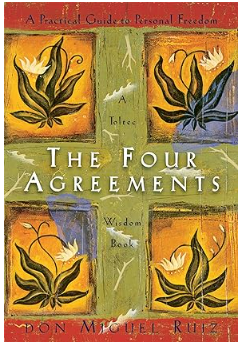
  • The Four Agreements — Don Miguel Ruiz

    The Four Agreements — Don Miguel Ruiz

    The Four Agreements introduces the idea that many of our beliefs began as someone else’s opinions. Parents, teachers, religious leaders, and others teach us how life is supposed to work long before we can distinguish opinion from fact. As we adopt these ideas as beliefs, we make agreements with them. But what happens when an agreement no longer serves us? Can we change it? Absolutely. Drawing from the Toltec tradition, Don Miguel Ruiz suggests replacing limiting beliefs with four agreements: Be impeccable with your word. Don’t take anything personally. Don’t make assumptions. Always do your best.

    I recommend this book to anyone interested in understanding how their beliefs developed and how those beliefs influence their daily experiences. It offers a practical way to examine the assumptions we’ve carried through life, question what we’ve accepted as truth, and begin choosing beliefs that support greater peace and personal growth.

    I first read this book in 2017, and it changed the direction of my life. The second agreement, don’t take anything personally, had the greatest impact. I remember leaving my office the day I read it and waiting in my truck to turn onto the road. As another truck passed, I made eye contact with a young man in the passenger seat. He was laughing. Immediately, I became defensive. What’s he laughing at?! As I drove toward the stoplight, I imagined all sorts of reasons this guy might be laughing at me and what I’d say if I confronted him. Then, suddenly, I remembered: Don’t take anything personally. My anger dissolved, I laughed at myself, and said, “Now I get it!” I had observed something, invented a story about it, and made myself angry over a situation I knew almost nothing about. He might have been laughing at me, but why assume that? And even if he was, why make it my problem? By letting go of that anger, I also avoided carrying it home to my family.

    Since then, I’ve recommended this book to countless people and given away dozens of copies. Not everyone connects with it, and I’ve learned that’s perfectly fine. We’re all traveling our own paths, and what changes one person’s life may mean nothing to another. But for those who are ready to question their agreements, this little book might open the door to an entirely different experience of life. And if it doesn’t, that’s great, too.

    A few years ago I made this 8-bar song based on The Four Agreements as part of a challenge issued by YouTube personality Pete Johns.

  • Is There a Purpose to Life?


    What is the purpose of life?

    It’s a question many of us (perhaps all) have asked at some point. I’ve asked it many times—on my blog, in conversation, and especially in the counseling room. Some people have an answer ready. Others don’t. And over the years, I’ve realized that’s okay.

    For a long time, I thought everyone should have an answer. Growing up in a structured religious system, I was taught to ask and answer three core questions:
    Where did I come from? Why am I here? Where am I going?
    These were foundational, woven into every lesson and conversation. Purpose was a given.

    But when I started asking people outside that structure—particularly people in recovery—many didn’t have an answer. And why would they? If you’re emerging from rock bottom, battling addiction, struggling with the weight of trauma and shame… purpose can feel impossibly out of reach.

    And yet, the question doesn’t go away.


    From Indoctrination to Inquiry

    My personal beliefs have changed drastically over time. I no longer subscribe to the obedience-based model I was raised in, where you get one shot at life and are judged eternally based on how well you followed someone else’s rules. That belief created more fear than freedom. It kept me trapped in anxiety, trying to live up to an invisible standard.

    Today, I lean toward something more experiential. I see life as something we choose—before birth, after death, across lifetimes. A bit like changing shoes: each life is a new pair we put on for a specific purpose or experience.

    Maybe the point isn’t to be tested, but to experience.


    The Garden, The Amusement Park, and The Shoes

    Over time, I’ve come up with a few metaphors that help me relate to the idea of life’s purpose:

    The Garden

    We are gardeners in a cosmic garden, tending to what grows around us. Some of us plant vegetables. Others grow flowers. Some are caretakers of rock gardens or atomic gardens—beautiful or destructive. The question is not whether we’re gardening, but how.

    The Amusement Park

    Imagine waking up in an amusement park. You don’t know how you got there, why you’re there, or when you have to leave. But everything around you invites joy—rides, music, food, people. You can spend your time searching for meaning, or you can ride the roller coaster and eat the funnel cake.

    I spent a lot of years running around that park, too afraid to enjoy anything, worried I was doing it wrong. Maybe you have too. But what if the purpose is just to have fun while you’re here? To choose experiences that feel aligned. To live in the present.

    The Shoes

    The body is like a pair of shoes. Different shoes for different purposes—boots for mud, sneakers for running, sandals for summer. When a pair wears out, you don’t mourn forever. You just pick a new pair. Maybe life is like that: temporary, purposeful, changeable.


    Living Without Knowing

    At the end of the day, nobody really knows the purpose of life. Anyone who claims to is still speaking from their own subjective experience. Whether it’s a spiritual revelation, a psychedelic journey, or a moment of deep reflection—none of it is final truth. Just perspective.

    So what do we do with that?

    We choose a belief that serves us.

    I don’t believe we were put here to be judged. I don’t believe in eternal punishment for a single lifetime’s “failures.” I believe in experience, in awareness, in choice. And I believe that the less I worry, the better life feels.


    Finding Your Own Meaning

    You don’t need to adopt my metaphors. You don’t need to have the same beliefs. But I invite you to pause and ask:
    What is your purpose?
    Not the one you inherited, but the one that lights something inside you. Maybe it’s creating. Maybe it’s parenting. Maybe it’s healing, or helping, or simply existing in peace.

    Whatever it is, do it out of love—not fear. That shift alone can change everything.

    And if you don’t know your purpose yet, that’s okay. You’re allowed to enjoy the amusement park while you figure it out.